Tire Load Range E: Meaning, PSI, Weight Capacity and When to Use It
A plain-English guide to the 10-ply rating on trailer and truck tires
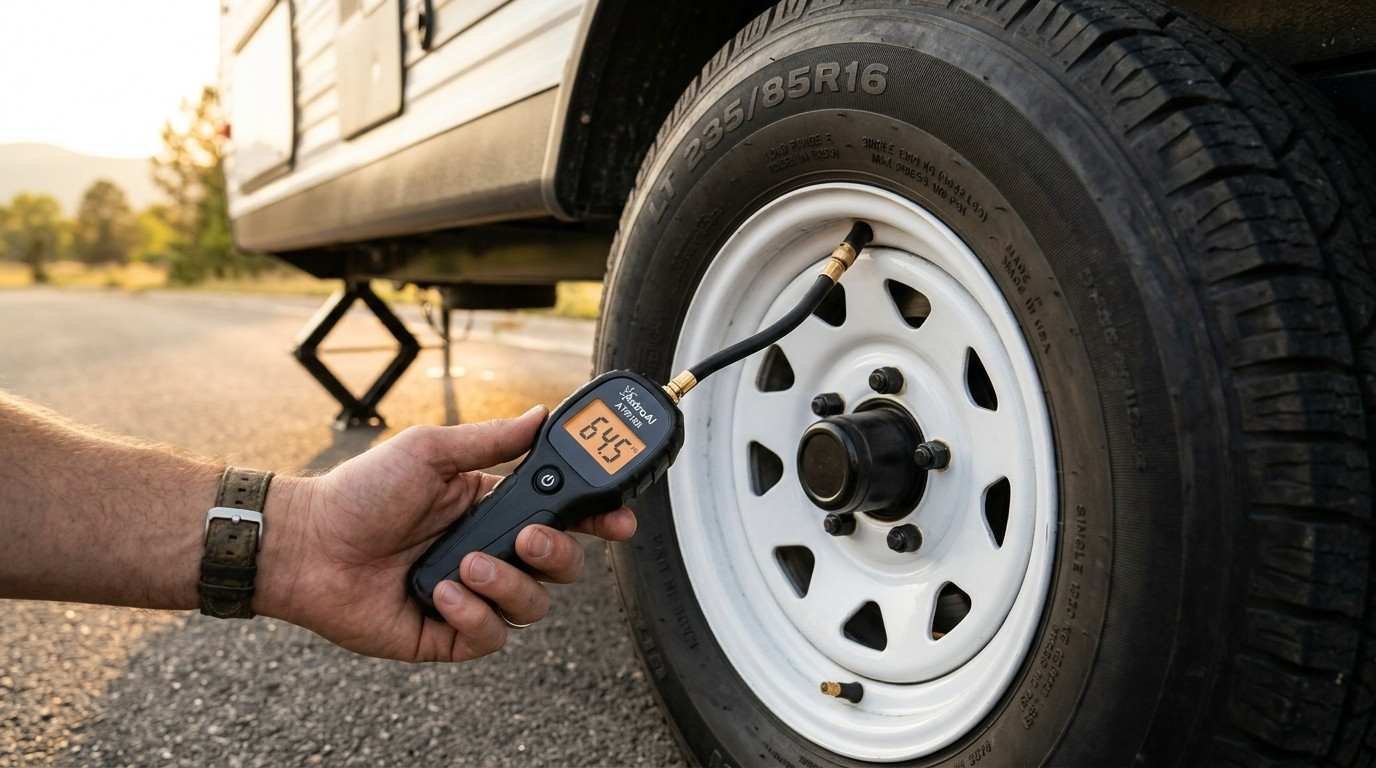
Walk down any trailer tire aisle and the same label keeps showing up: tire load range E. It sits right next to the size, and it quietly decides how much weight that tire can safely carry. Pick the wrong one and a camper, boat or car hauler can end up riding on tires that are working far past their limits.
This guide breaks down the tire load range E meaning in simple terms. It covers weight capacity, the 80 PSI rule, the difference between trailer (ST) and truck (LT) versions, and how load range E compares with C, D, F, XL and SL. Real sizes such as 205/75R15, ST225/75R15 and 20.5×8.0-10 are included, along with practical tips to help buyers choose with confidence.
Tire load range E is a 10-ply rating. It describes a heavy-duty tire built to run at up to 80 PSI (cold) on most trailer (ST) and light truck (LT) sizes. It carries more weight than load range C or D, and less than load range F. The exact capacity in pounds is printed on the sidewall and changes with tire size.
What Is Tire Load Range E?
Tire Load Range E Meaning
Load range is a letter code that shows a tire’s strength and how much air pressure it can handle. The letters run from B up through G, and each step up means a tougher internal structure and a higher maximum pressure. Load range E sits in the middle of the heavy-duty group and is rated at 10 plies.
So when someone asks what does tire load range E mean, the short version is this: it is a tire built for heavy loads, with stronger sidewalls and a higher inflation limit than a standard passenger tire.
Why “10-Ply Rating” Does Not Mean 10 Layers
Older tires really did use many layers of cotton cord. Modern tires use polyester, steel and nylon, so a tire marked 10-ply rating does not contain ten physical layers. The number is a strength equivalent. It tells buyers the tire performs like a bias-ply tire that once needed ten plies.
| Load Range | Ply Rating | Typical Max PSI (LT/ST) | Common Use |
|---|---|---|---|
| B | 4 | 35 PSI | Light-duty, older designs |
| C | 6 | 50 PSI | Light trailers, light-duty trucks |
| D | 8 | 65 PSI | Mid-weight trailers, 1/2-ton trucks |
| E | 10 | 80 PSI | Heavy trailers, 3/4-ton and 1-ton trucks |
| F | 12 | 95 PSI | Very heavy trailers, commercial use |
| G | 14 | 110 PSI | Severe-duty and commercial |
Pressures vary slightly by brand and size, so always trust the number molded into the sidewall of the actual tire.
Tire Load Range E Weight Capacity
Many shoppers search for a single number, such as “trailer tire load range E weight capacity.” The honest answer is that there is no single number. Load range E sets the strength class. The load index and tire size set the actual pounds.
Load Index Explained
The load index is the two or three digit number after the tire size. A tire marked 117/112, for example, has a single-tire index of 117 and a dual-tire index of 112. Each index matches a weight in pounds.
| Load Index | Approx. Capacity per Tire |
|---|---|
| 100 | 1,764 lbs |
| 105 | 2,039 lbs |
| 110 | 2,337 lbs |
| 115 | 2,679 lbs |
| 120 | 3,086 lbs |
| 125 | 3,638 lbs |
| 130 | 4,189 lbs |
Example: Reading a Real Tire
Take an ST225/75R15 load range E tire marked 117/112. Index 117 equals roughly 2,830 lbs on a single tire at max pressure. On a tandem-axle trailer with two tires per axle, the combined capacity is simply the sum of the tires, but the weight should still sit evenly across them.
Tire Load Range E PSI
Most load range E tires have a maximum cold inflation pressure of 80 PSI. That is more than double the 32 to 35 PSI typical of a passenger tire, and about 60 percent higher than a load range C tire at 50 PSI.
Why the Higher Pressure Matters
The tire reaches its full rated load only when it is inflated to the pressure printed on the sidewall. Run it lower and the capacity drops, the sidewalls flex more, heat builds up, and blowouts become more likely. This is one of the most common reasons trailer tires fail.
Cold vs Hot Pressure
- Check cold. Measure before driving or after the tire has rested for at least three hours.
- Expect a rise. Tires typically gain a few PSI as they warm up on the road. Do not bleed air from a hot tire.
- Trailer tires: Many trailer tire makers recommend running at max sidewall pressure.
- Truck tires (LT): Follow the door-jamb placard for the truck, and adjust upward when towing, never above the sidewall maximum.
Trailer Tire Load Range E
Trailer tires are labeled ST (Special Trailer). They have stiffer sidewalls that resist sway and carry steady loads. Load range E is one of the most popular choices for travel trailers, horse trailers, car haulers, enclosed cargo trailers and larger boat trailers.
Common Trailer Tire Load Range E Sizes
| Size | Rim | Typical Use |
|---|---|---|
| ST145R12 | 12″ | Small utility and cargo trailers |
| 20.5×8.0-10 | 10″ | Compact utility, lawn and small boat trailers |
| 205/75R14 | 14″ | Utility, boat and small camper trailers |
| 205/75R15 | 15″ | Boat, utility and mid-size camper trailers |
| ST225/75R15 | 15″ | Travel trailers, horse trailers, car haulers |
| ST235/80R16 | 16″ | Heavier travel trailers, cargo and equipment trailers |
Not every brand makes load range E in every size, so availability depends on the manufacturer.
20.5×8.0-10 Trailer Tire Load Range E
The 20.5×8.0-10 is a compact size used on small trailers. In load range E it carries roughly 1,800 lbs per tire at max pressure, depending on the brand. Always confirm the number on the sidewall before buying.
205/75R15 and 205/75R14 Trailer Tires
These are two of the most searched sizes. The 14-inch and 15-inch versions look nearly identical on a shelf, but the rim size must match exactly. A 205/75R14 will not fit a 15-inch wheel, so check the wheel stamp first.
ST Tires Are for Trailers Only
ST tires are built for towing, not steering or driving. Using them on a pickup or SUV is unsafe and not recommended. Many ST tires are also rated for about 65 mph, so slow down on long hauls unless the sidewall says otherwise.
Truck Tire Load Range E
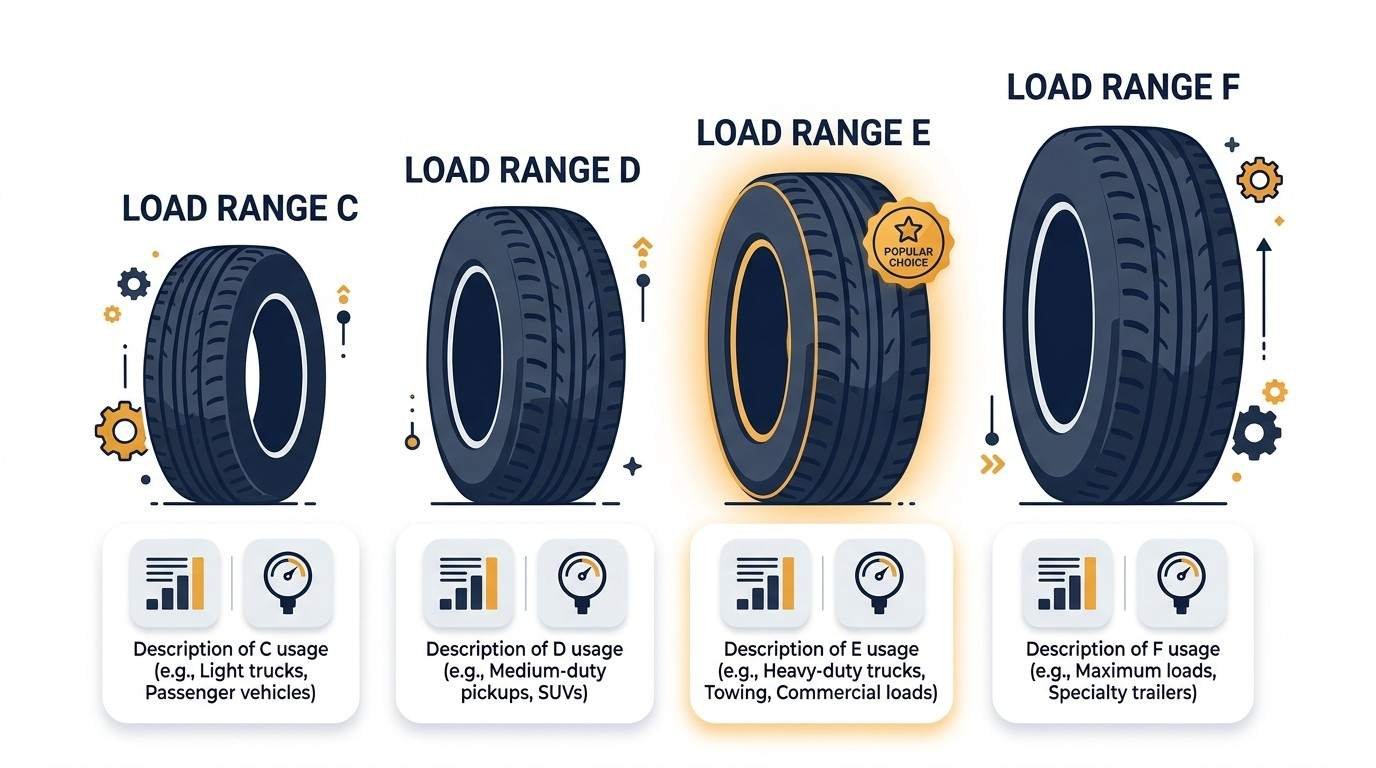
On trucks the letters show up on LT (Light Truck) tires. Load range E is common on 3/4-ton and 1-ton pickups such as the Ford F-250, Ram 2500 and Chevy Silverado 2500, and on SUVs and vans that tow regularly. Typical sizes include LT245/75R16, LT265/70R17, LT275/65R20 and LT285/75R16.
Benefits for Truck Owners
- Stronger sidewalls for towing and hauling.
- Better puncture resistance off-road and on job sites.
- Higher payload and tow capacity support.
Trade-offs
- A firmer ride when the truck is empty.
- Slightly higher price and weight.
- More road noise on some tread patterns.
Heavy truck tires also come in wide sizes. Readers comparing options can use the 275 tire size in inches, 295 tire size in inches and 315 tire size in inches guides to translate metric sizes into real-world measurements. Brand comparisons are also covered in the Cooper tire reviews.
Tire Load Range E vs C, D, F, XL and SL
| Feature | Load Range C | Load Range D | Load Range E | Load Range F |
|---|---|---|---|---|
| Ply rating | 6 | 8 | 10 | 12 |
| Max PSI | 50 | 65 | 80 | 95 |
| Strength | Light | Medium | Heavy | Very heavy |
| Ride when empty | Softest | Moderate | Firm | Firmest |
| Best for | Small trailers | Mid trailers | Heavy trailers, 3/4-ton trucks | Commercial, very heavy loads |
Tire Load Range E vs F
Load range F steps up to 12 plies and about 95 PSI. It suits very heavy trailers and commercial work. For most travel trailers and pickups, E is already enough, and F can ride harder than necessary.
Tire Load Range E vs C and D
Load range C (6-ply) and D (8-ply) suit lighter trailers. Choosing E when the axle weight calls for D adds a safety margin, though it may cost a little more. Moving down from E to C on a loaded trailer is where problems start.
Tire Load Range E vs XL and SL
XL (Extra Load) and SL (Standard Load) belong to passenger and P-metric tires. SL tires typically use a 35 PSI reference and XL tires use 41 PSI. These are not the same system as LT and ST load ranges, and load range E is far stronger than either in the same size. Compare the load index, not just the letters, when sizes differ.
Do You Need Load Range E?
Load range E makes sense in these situations:
- The trailer’s axle rating is high, or the trailer is often loaded close to capacity.
- The trailer is a travel trailer, fifth wheel, horse trailer or car hauler.
- A 3/4-ton or 1-ton truck tows regularly or carries a camper.
- Driving includes gravel, job sites or rough roads where sidewall strength helps.
Pros
- Higher load capacity and a bigger safety margin
- Tough sidewalls that resist sway
- Better heat handling under load
- Longer service life when kept inflated
Cons
- Costs more than C or D
- Stiffer ride on lightly loaded vehicles
- Needs a gauge that reads up to 80+ PSI
- Rim must be rated for the pressure
Budget matters too. A full set of heavy-duty tires adds up, so readers can see typical pricing in how much is a new tire and plan for a spare using how much is a spare tire.
How to Find the Load Range on a Tire
The load range is molded into the sidewall, usually in small letters near the size. A typical trailer tire might read:
ST225/75R15 117/112L LOAD RANGE E | MAX LOAD 2830 LBS (1285 KG) @ 80 PSI COLD
- ST: Special Trailer tire.
- 225/75R15: width in mm, aspect ratio, radial construction, rim diameter in inches.
- 117/112: load index for single and dual use.
- Load Range E: the 10-ply strength class.
- Max load and PSI: the true working limits.
Next to it is the DOT code, which shows when the tire was made. Learn to decode it with the DOT tire date code guide and the how to tell tire age article. For the wider picture on rating systems, the tire load rating guide covers the full chart.
Practical Tips for Load Range E Tires
- Check pressure monthly and before every long trip, with a quality gauge.
- Replace by age, not just tread. Many tire makers suggest having trailer tires inspected after five years and replacing them around six, even if the tread looks fine.
- Never mix ST and LT tires on the same axle, and avoid mixing load ranges.
- Cover trailer tires in storage to reduce sun and ozone cracking.
- Balance and install correctly. See typical fees in mount and balance cost and tire installation cost.
- Rotate and inspect regularly. A reference for pricing is Valvoline tire rotation cost.
- Know your repair options. A nail in a heavy-duty tire can sometimes be fixed. Read whether Discount Tire patches tires for free.
- Carry a spare that matches the load range.
- Winter towing? See the best tire chains guide.
Common Mistakes to Avoid
- Buying by size only and ignoring load range.
- Running below the sidewall PSI to get a softer ride.
- Putting ST trailer tires on a truck.
- Ignoring the rim’s maximum pressure rating.
- Skipping a TPMS check on the tow vehicle (see TPMS replacement cost).
For safety standards and tire care basics, the NHTSA tire safety page and the U.S. Tire Manufacturers Association are trustworthy references.
Frequently Asked Questions
What does tire load range E mean?
Tire load range E means the tire has a 10-ply rating and is designed for heavy loads at up to 80 PSI. It is stronger than load range C or D and lighter-duty than F.
How much weight can a load range E tire hold?
It depends on the size. Many trailer sizes carry between roughly 1,800 and 3,500 lbs per tire at max pressure. The sidewall shows the exact limit.
Is load range E better than load range D?
Load range E is stronger and handles more weight and pressure, so it is better for heavy trailers and trucks. For light loads, D can ride softer and cost less.
What PSI should load range E tires run?
Trailer tires usually run at the max sidewall pressure, commonly 80 PSI. Truck tires should follow the vehicle placard, adjusted for load, without going over the sidewall maximum.
Can I use load range E tires on a car or light SUV?
Only if the size matches the vehicle’s requirements and the manufacturer allows it. The ride will be firmer, and ST trailer tires should never be used on cars or SUVs.
Conclusion
Tire load range E is a 10-ply, 80 PSI strength class built for heavy trailers and 3/4-ton or 1-ton trucks. It sits above load range C and D and below F, and it is not the same system as passenger XL and SL tires. The sidewall’s load index, max load and max PSI tell the full story for any size, whether it is a 20.5×8.0-10, a 205/75R15, an ST225/75R15 or an LT truck tire.
Match the tire to the axle rating, keep it inflated to spec, watch its age, and never mix tire types. Do that and a load range E tire will carry its load safely mile after mile.