How Much Is a New Tire? 2026 Price Guide by Size & Type
Real price ranges for cars, SUVs and trucks, plus installation fees, store comparisons and money-saving tips.
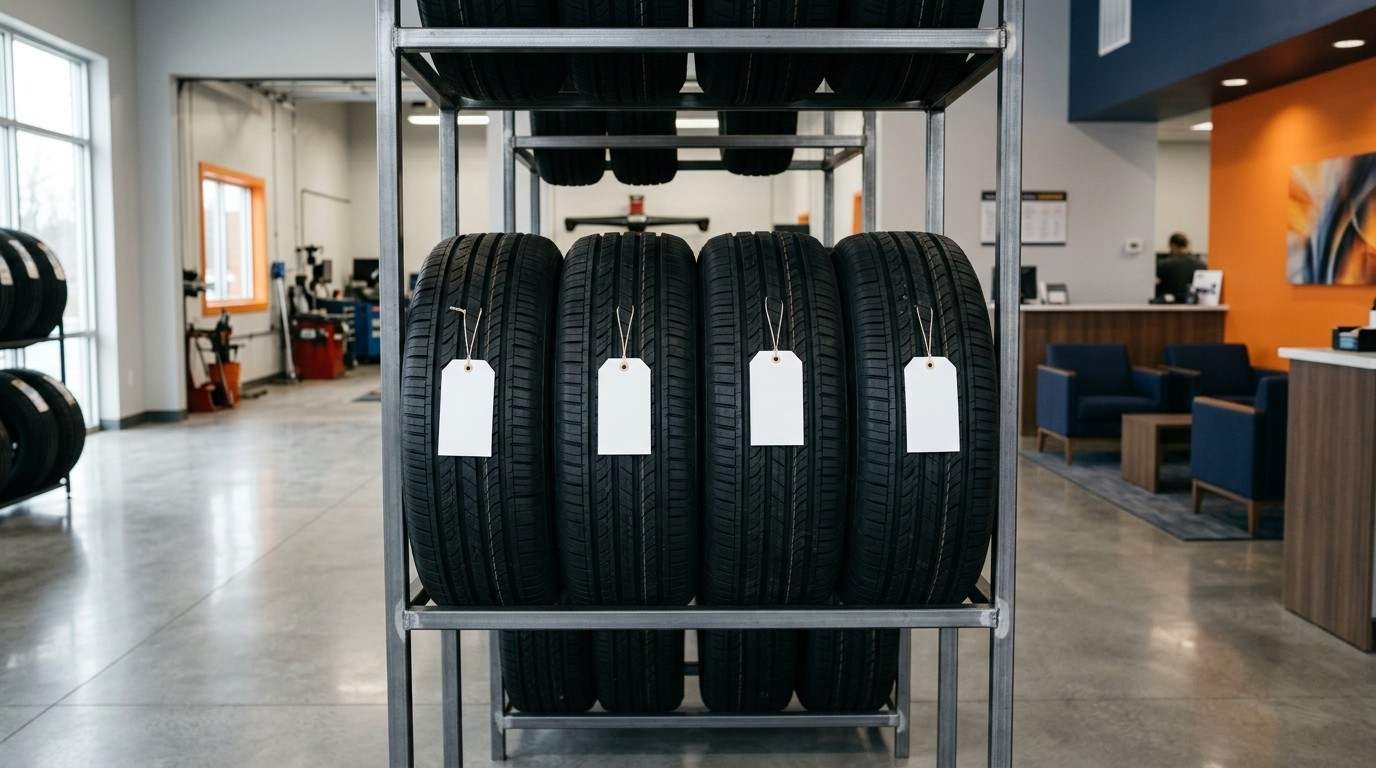
How much is a new tire? A new passenger-car tire typically costs $100–$250 per tire in 2026, or about $400–$1,200 for a set of four. Mounting, balancing, disposal and valve stems usually add $15–$50 per tire, so the realistic out-the-door price for one installed tire runs about $120–$300 for most vehicles. Trucks, SUVs, EVs and performance tires cost more.
Few car expenses cause as much sticker shock as a set of tires. The price on the website is rarely the price at the register, and the same tire size can cost very different amounts depending on brand, retailer, region and installation fees. That is why the question how much is a new tire has no single number for an answer.
This guide breaks the cost down in plain language. It covers prices by tire type, vehicle and store, explains what installation actually includes, and shows how drivers can avoid paying for extras that are not needed. Related costs such as a new tire pressure sensor, a new rim and a bicycle tire are covered as well.
How Much Is a New Tire by Tire Type?
Tire category is the biggest driver of price. A basic all-season tire for a compact sedan and a high-performance summer tire may share a rim size, yet the second can cost three times as much.
| Tire type | Typical price per tire | Best suited for |
|---|---|---|
| Budget all-season | $60–$120 | Low-mileage, cost-focused driving |
| Mid-range all-season / touring | $100–$180 | Daily commuting, balanced comfort and tread life |
| Premium all-season | $160–$280 | Longer tread life, quieter ride, better wet grip |
| Winter / snow | $100–$300 | Cold climates and snow-covered roads |
| All-terrain (truck / SUV) | $150–$350 | Mixed on-road and off-road use |
| Performance / ultra-high-performance | $180–$450 | Sport sedans, coupes and sports cars |
| Run-flat | $200–$500 | Vehicles designed without a spare |
| EV-specific | $180–$400 | Electric vehicles that need low rolling resistance and higher load capacity |

Budget versus premium: is the gap worth it?
A cheaper tire is not automatically the cheaper choice. Many budget tires wear out sooner, while premium tires often reach 50,000 to 70,000 miles. A $90 tire that lasts 35,000 miles costs about 0.26 cents per mile, while a $170 tire that lasts 65,000 miles costs about the same, with better wet braking as a bonus.
Drivers who want a closer look at premium options can read the guides on the Goodyear Assurance tire line and the performance-focused Pirelli P Zero tire. For a wider view of manufacturers, the tire brands directory lists popular names side by side.
How Much Is a New Tire for a Car, SUV or Truck?
Vehicle size matters because larger wheels, wider treads and higher load ratings all raise manufacturing costs.
| Vehicle class | Typical price per tire |
|---|---|
| Compact car | $80–$170 |
| Midsize sedan | $100–$220 |
| Crossover / small SUV | $120–$280 |
| Minivan | $120–$250 |
| Full-size pickup / large SUV | $160–$350 |
| Luxury / performance car | $200–$450+ |
How much is a new tire for popular cars?
Searches for specific models are common, so the table below shows approximate pricing for five best-selling sedans. Exact size depends on trim and wheel diameter, and the correct size is always printed on the tire sidewall and the driver-door placard.
| Model | Common size range | Typical price per tire |
|---|---|---|
| Toyota Corolla | 195/65R15 to 225/40R18 | $90–$160 |
| Honda Civic | 215/55R16 to 235/40R18 | $95–$170 |
| Honda Accord | 225/50R17 to 235/40R19 | $115–$210 |
| Toyota Camry | 205/65R16 to 235/40R19 | $110–$200 |
| Ford Focus | 195/65R15 to 235/40R18 | $85–$150 |
How Much Is a New Tire and Installation?
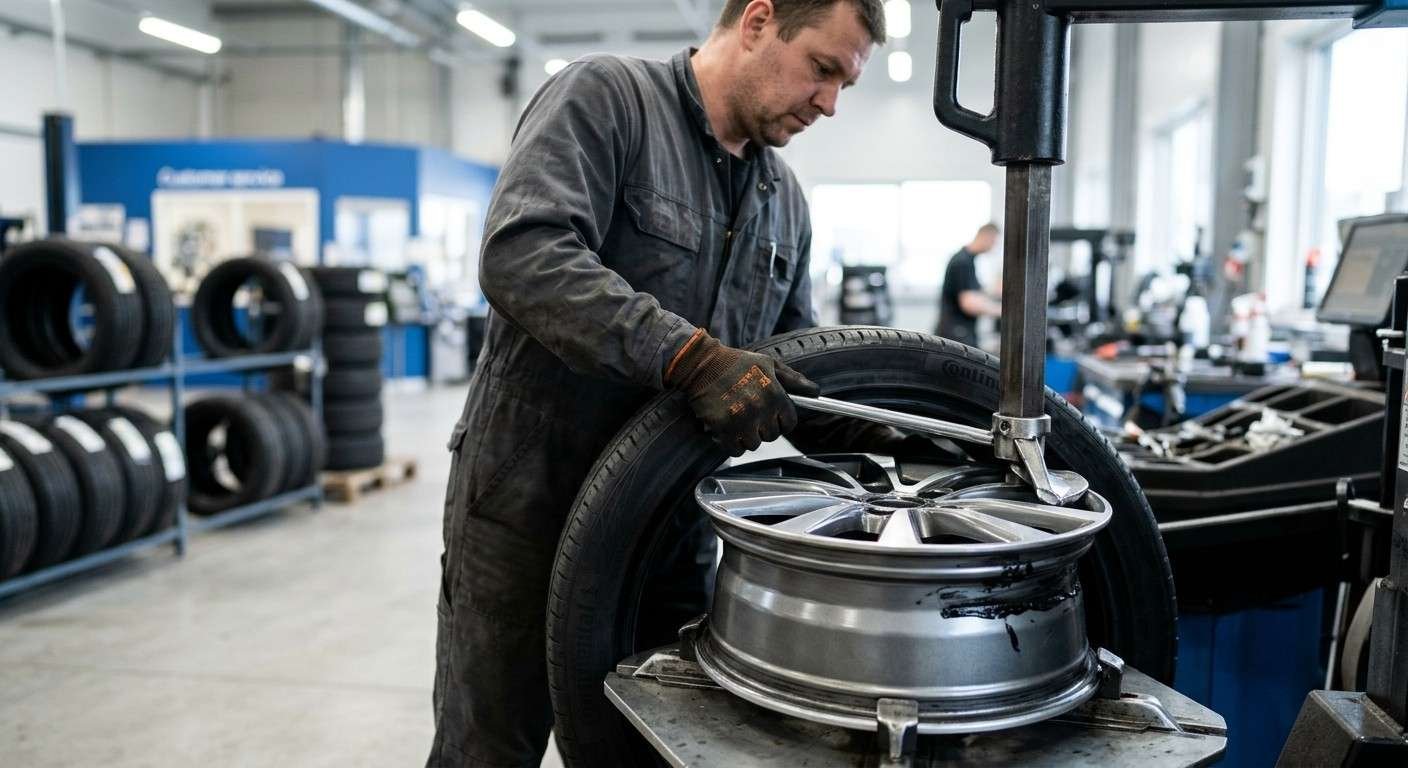
Installation is where many budgets go off track. A shop quote usually bundles several small services, and each one is priced per tire or per vehicle.
| Service | Typical cost | What it covers |
|---|---|---|
| Mounting | $8–$25 per tire | Removing the old tire and fitting the new one on the wheel |
| Balancing (standard) | $10–$20 per tire | Adding small weights to prevent vibration |
| Road-force balancing | $20–$40 per tire | Diagnosing hard-to-fix vibrations |
| Valve stem | $3–$10 per tire | New rubber valve or TPMS service kit |
| Old tire disposal | $2–$6 per tire | Environmental and recycling fee, sometimes state-mandated |
| TPMS reset or service kit | $5–$15 per wheel | Re-learning or servicing the pressure monitoring system |
| Wheel alignment | $75–$150 per vehicle | Adjusting suspension angles to protect new tires |
| Typical bundled install | $15–$50 per tire | Mounting, balancing, valve stem and disposal combined |
What a free installation offer really means
Some retailers advertise free installation. In practice, part of that labor may be recovered through the tire price, membership dues or a narrower service package. The best way to compare is to ask for the final price with tax, fees and disposal included.
Questions worth asking before paying
- Does the quote include valve stems, TPMS service kits and disposal?
- Is balancing per tire or included in a package?
- Are rotations and flat repairs free for the life of the tire?
- Is there an extra charge for large wheels, low-profile tires or lifted trucks?
For a deeper look at labor charges, see the tire balancing cost breakdown.
How Much Do Four New Tires Cost Installed?
Most drivers replace tires in sets of four, or at least in pairs. The following scenarios show realistic budgets.
| Scenario | Tires (set of 4) | Installation | Estimated total |
|---|---|---|---|
| Budget tires on a compact car | $320–$480 | $60–$120 | $380–$600 |
| Mid-range tires on a midsize sedan | $480–$720 | $80–$160 | $560–$880 |
| Premium tires on a crossover or SUV | $800–$1,200 | $100–$200 | $900–$1,400 |
| All-terrain tires on a pickup | $800–$1,400 | $100–$240 | $900–$1,640 |
Example: replacing tires on a Honda Civic
Consider a driver with a Honda Civic using 215/55R16 tires. Mid-range tires at about $120 each total $480. Installation at $30 per tire adds $120, and an optional alignment adds roughly $100. The final bill lands near $700, which sits comfortably inside the mid-range scenario above.
Drivers who cannot pay the full amount at once can look at wheel and tire financing or the Tire Plus credit card. Both are worth reading carefully, because deferred-interest offers can become expensive if the balance is not cleared in time.
How Much Is a New Tire at Walmart, Costco and Discount Tire?
Where tires are bought affects both price and what comes with them. Retailer policies change, so the points below are general patterns rather than guarantees.
| Retailer type | Installation pricing pattern | Notable points |
|---|---|---|
| Walmart | Installation packages commonly in the low-to-mid $20s per tire | Wide selection, frequent promotions, convenient locations |
| Costco | Roughly $15–$25 per tire for installation on tires bought there | Membership required; installation packages typically include balancing and rotation |
| Discount Tire | Installation priced into the purchase; fees vary by region and state | Strong tire-only focus; lifetime balancing and rotation on tires bought there |
| Sam’s Club | Package pricing varies by location | Membership required; check what the package includes |
| National chains (Firestone, Mavis, Midas) | Often $20–$30 per tire | Frequent coupons and financing; prices vary by franchise |
| Independent local shops | Varies widely | Personal service and price matching are common |
Walmart
Walmart is popular for its large selection and easy online ordering. Before booking, drivers should read the current Walmart tire sale guide to see how promotions work.
Costco and Sam’s Club
Warehouse clubs often compete on bundled value. Warranty terms matter as much as price here, so the Costco tire warranty guide and the Sam’s Club tire center guide are useful before checkout.
Discount Tire and national chains
Seasonal sales can cut the price meaningfully. The Discount Tire Black Friday guide and the Mavis tire coupons page show how shoppers time their purchases.
What Makes a New Tire Cost More?
Understanding the drivers of price makes quotes easier to judge.
Size and wheel diameter
Larger diameters and wider treads use more material. Moving from a 16-inch to an 18-inch wheel can add $30 to $80 per tire.
Brand and technology
Premium brands invest in compounds, noise reduction and wet-weather performance. Mid-tier and store brands often deliver good value for ordinary commuting.
Speed rating and load index
Higher speed ratings and load capacities require stronger construction. Trucks and SUVs often need load-range E or XL tires, which cost more.
Special features
- Run-flat construction: reinforced sidewalls raise the price.
- Noise-reducing foam: common on premium and EV tires.
- Severe-snow rating: winter compounds and the three-peak mountain snowflake symbol add cost.
Timing and region
Spring and fall changeover seasons, holiday sales and local labor rates all move the final price. Coastal and Northeastern markets often have higher labor charges than Midwestern ones.
When Is a New Tire Actually Needed?
Paying for tires too early wastes money, and waiting too long risks safety. The U.S. National Highway Traffic Safety Administration has estimated that roughly 11,000 crashes a year involve tire-related problems, which is why timely replacement matters.
Check tread depth
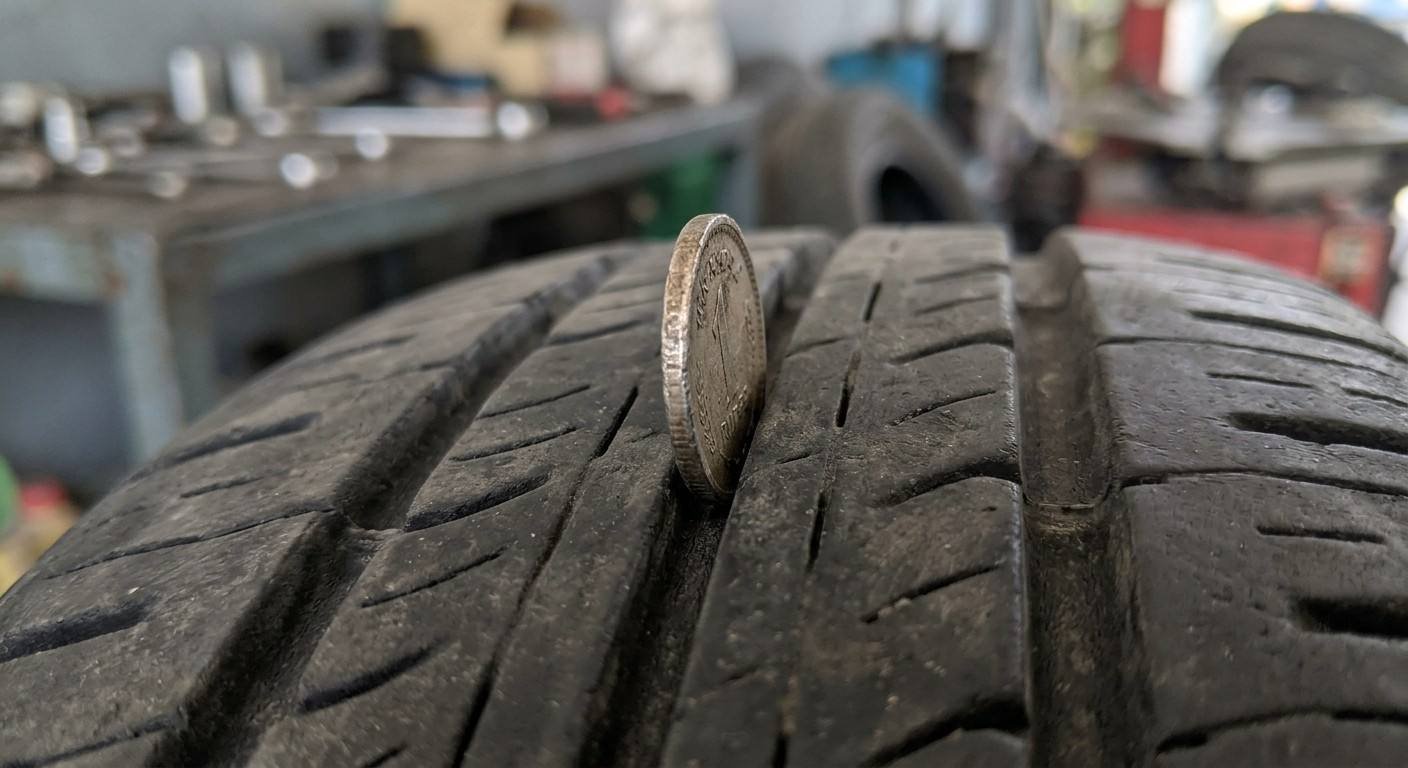
The legal minimum in most states is 2/32 of an inch. The penny test is a quick check: with Lincoln’s head pointing down in the groove, visible hair above his head means the tread is at or below the limit. Many experts suggest replacing wet-weather tires at 4/32 of an inch for safer braking.
Check the age
Rubber hardens over time even when tread looks fine. Many manufacturers advise inspection after about six years and replacement by around ten. The four-digit DOT code on the sidewall shows the week and year of manufacture, and the guide to reading tire date codes explains how to decode it.
Look for damage
- Cracks, bulges or bubbles in the sidewall
- Nails or punctures too close to the shoulder to repair
- Uneven wear that points to alignment or suspension trouble
- Persistent vibration after balancing
Replacing one tire or all four?
Replacing a single tire is possible when the others have decent tread and the new one matches in size and type. All-wheel-drive vehicles are more sensitive to differences in tire circumference, so owners should check the vehicle manual or ask the shop about matching or shaving the new tire.
How to Save Money on New Tires
A few habits can lower the bill without lowering quality.
- Compare out-the-door prices. Include tax, disposal, valve stems and TPMS service.
- Collect at least three quotes. Online retailers, warehouse clubs and local shops often differ by $20 to $60 per tire.
- Time the purchase. Holiday weekends and seasonal rebates can bring instant savings, and the tire blog tracks current deals.
- Check manufacturer rebates. Prepaid cards and mail-in offers can return $50 to $100 on a set.
- Choose the right category. Paying for ultra-high-performance tires on a family commuter rarely makes sense.
- Verify the date code. Fresh tires last longer than old stock.
- Protect the investment. Rotate tires regularly, keep pressure at the door-placard level and align the wheels when needed.
- Read the warranty. Treadwear, road-hazard and free-rotation terms vary a lot.
Common mistakes to avoid
- Shopping by price alone without checking date codes or treadwear warranties
- Skipping alignment on a vehicle that already pulls to one side
- Ignoring a TPMS warning light after installation
- Mixing very different tire types on one axle
Tire shop owners and service providers who want to be included in local searches can use the business submission page, and shoppers can browse more options on the tire services page.
Frequently Asked Questions About New Tire Prices
How much is one new tire?
One new passenger-car tire usually costs $100 to $250 before installation. Budget tires start near $60 to $100, while performance, run-flat and large truck tires can pass $350. Mounting and balancing typically add $15 to $50 per tire.
How much does it cost to put four new tires on a car?
Four new tires with installation typically cost $450 to $1,350 for most cars and crossovers. Compact cars with budget tires land near the low end, while SUVs, trucks and performance tires land near the high end.
How much is a new tire pressure sensor?
A new TPMS sensor commonly costs $50 to $100 per sensor installed, though luxury vehicles can cost more. A simple sensor reset or service kit is far cheaper, often $5 to $15 per wheel.
Can I replace just one tire?
Yes, if the other tires still have enough tread and the new tire matches the size and type. All-wheel-drive vehicles are more sensitive to tread-depth differences, so owners should check the manufacturer’s guidance, since a shop may recommend shaving the new tire or replacing a pair.
How often do new tires need to be replaced?
Most tires last about 40,000 to 70,000 miles, but they should be replaced sooner if tread reaches 2/32 inch, if the sidewall is cracked or bulging, or when the tire is roughly six to ten years old, depending on manufacturer guidance.
Conclusion: How Much Is a New Tire in 2026?
So, how much is a new tire? For most passenger vehicles, the answer is about $100–$250 per tire, plus $15–$50 for installation, which brings a full set of four to roughly $450–$1,350 out the door. Compact cars with budget tires sit at the bottom of that range, while trucks, SUVs, EVs and performance models sit at the top.
The smartest approach is simple: confirm the correct size, choose the right tire category, compare out-the-door quotes from several sellers, check the date code and read the warranty. Drivers who follow those steps usually avoid surprise fees and get more miles per dollar.
For more buying help, explore the Tire Near Me Hub homepage, browse the tire blog or search the state directory for a shop nearby.
Helpful Links and Resources
Website pages
Related tire guides
Trusted external sources
Last updated: . Prices are estimates and may vary by location, retailer and promotion.