DOT Tire Date Code: How to Read It, Chart & Examples
Find your tire’s age in under 30 seconds · Last updated: October 22, 2026
Most drivers check tread depth and air pressure. Far fewer check how old their tires are. Yet the DOT tire date code molded into the sidewall is the only reliable way to know when a tire was made, and rubber ages whether or not the tread looks fine.
A tire that sat in a warehouse for two years, or on a spare mount for nine, can look brand new and still carry hidden aging. This guide explains exactly how to read the code, how to decode it with a simple chart, and when an older tire should be replaced.
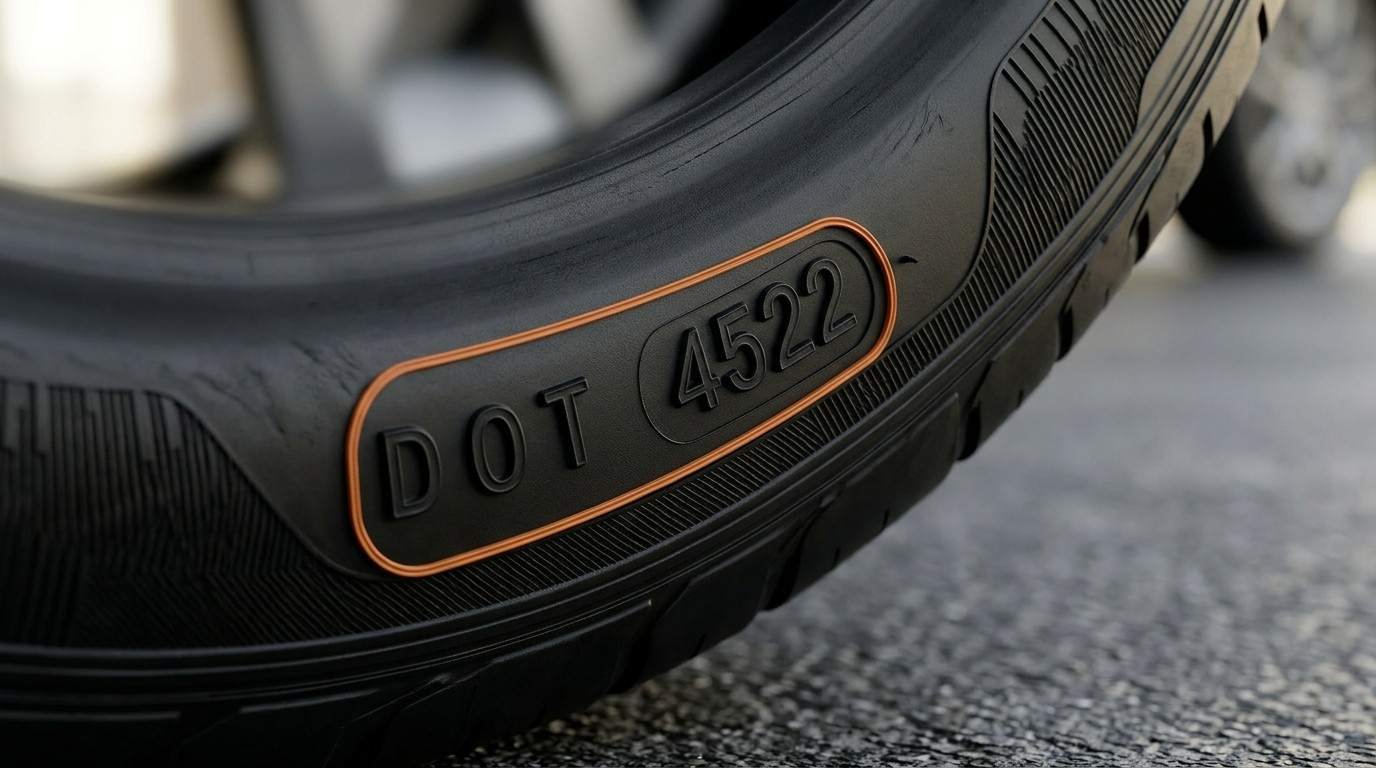
What Is the DOT Tire Date Code?
“DOT” stands for the U.S. Department of Transportation. Every tire sold for road use in the United States must carry a Tire Identification Number (TIN) that begins with those three letters. The rule comes from federal safety standards enforced by the National Highway Traffic Safety Administration (NHTSA).
The TIN works like a birth certificate. It tells you who made the tire, where, what size family it belongs to, and, most usefully for owners, when. The date portion is what most people mean by the “DOT tire date code.”
What Each Part of the DOT Code Means
| Segment | Meaning | Example |
|---|---|---|
| DOT | Confirms the tire meets U.S. federal standards | DOT |
| Plant code (2 characters) | The factory that produced the tire | XX |
| Size code (2 characters) | Internal tire-size identifier | YY |
| Manufacturer option (up to 4) | Brand-specific tread or type code | ZZZZ |
| Date code (4 digits) | Week and year of manufacture | 2423 |
Only the final four digits matter for age. The characters before them differ from brand to brand and do not need to be decoded to work out how old your tire is.
Where to Find the DOT Date Code on a Tire Sidewall
Look at the lower portion of the sidewall, close to the wheel rim. The full code is molded in raised characters, often in a small oval or rectangular area.
Step-by-Step: Locating the Code
- Park on level ground and use a flashlight. Dirt and brake dust can hide the characters.
- Wipe the lower sidewall with a damp cloth.
- Look for the letters DOT followed by a mix of letters and numbers.
- If the date side faces inward, you may need to turn the steering wheel fully or use your phone camera to see it.
- Take a close-up photo so you can zoom in and read the digits clearly.
How to Read the DOT Tire Date Code (4-Digit Format)
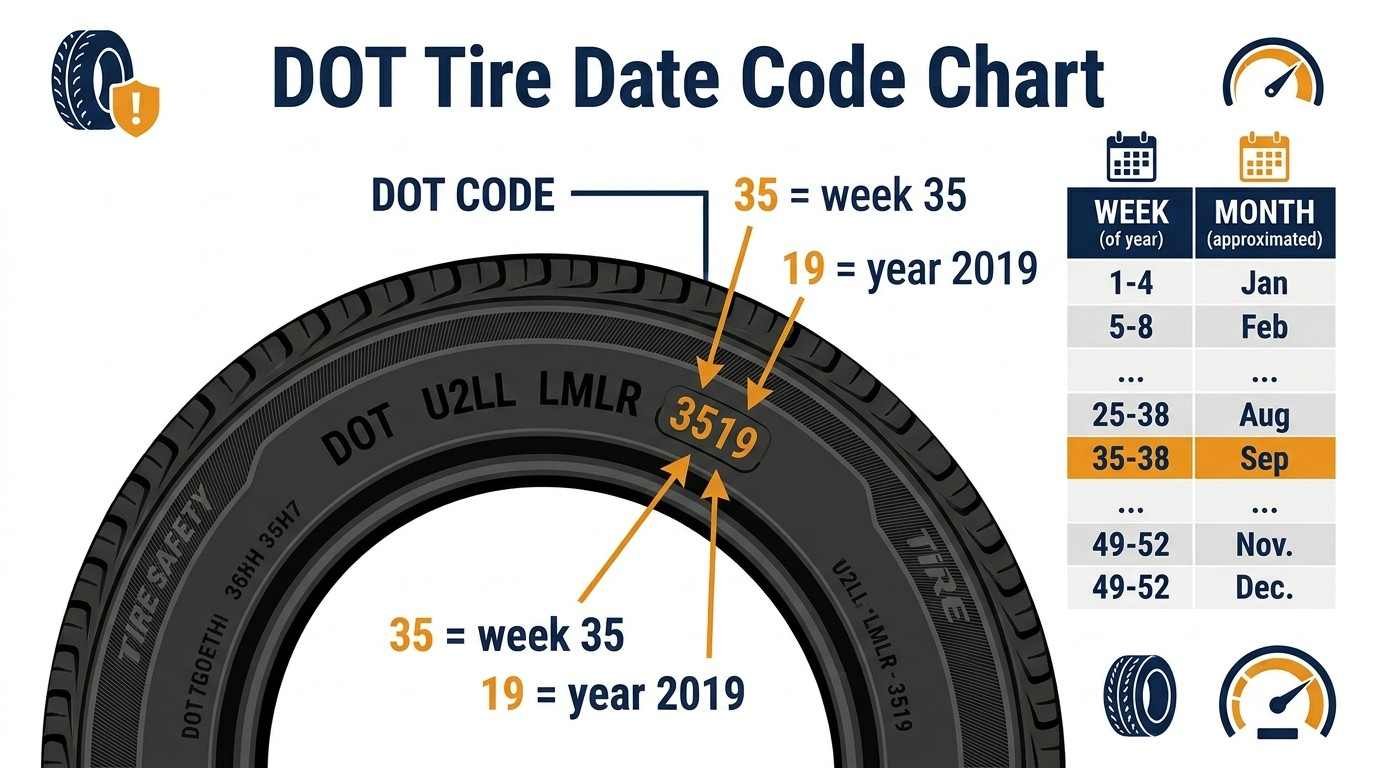
For any tire made in the year 2000 or later, the date code is four digits in the format WWYY.
- WW = week of the year, from 01 to 52
- YY = last two digits of the year
The Simple Three-Step Method
- Find the last four digits of the DOT code.
- Split them in two. The first pair is the week; the second pair is the year.
- Add the year to 2000 and match the week to a month using the chart below.
What About the Letters After the Digits?
Some tires, such as those sold in specific markets, may carry extra characters after the four digits. The date is still the four-digit group, and it is typically the final numeric group of the code. If you are unsure, compare it with the manufacturer’s guidance or ask a tire shop to confirm.
DOT Tire Date Code Chart: Week-to-Month Lookup
Use this chart as a quick decoder. Weeks are approximate because week 1 begins in early January and the manufacturing calendar can differ slightly by plant.
| Week Numbers | Approximate Month | Example Code | Decoded |
|---|---|---|---|
| 01 – 04 | January | 0324 | January 2024 |
| 05 – 08 | February | 0623 | February 2023 |
| 09 – 13 | March | 1122 | March 2022 |
| 14 – 17 | April | 1621 | April 2021 |
| 18 – 22 | May | 2020 | May 2020 |
| 23 – 26 | June | 2423 | June 2023 |
| 27 – 30 | July | 2825 | July 2025 |
| 31 – 35 | August | 3319 | August 2019 |
| 36 – 39 | September | 3724 | September 2024 |
| 40 – 44 | October | 4219 | October 2019 |
| 45 – 48 | November | 4622 | November 2022 |
| 49 – 52 | December | 5123 | December 2023 |
DOT Tire Date Code Lookup by Age (as of October 2026)
| Year Digits | Year Made | Approx. Age Now | Status |
|---|---|---|---|
| 26 / 25 | 2026 / 2025 | Under 2 years | Fresh |
| 24 / 23 | 2024 / 2023 | 2–3 years | Good |
| 22 / 21 | 2022 / 2021 | 4–5 years | Inspect yearly |
| 20 | 2020 | About 6 years | Get a professional inspection |
| 19 / 18 / 17 / 16 | 2019–2016 | 7–10 years | Replacement advised |
| 15 or earlier | 2015 or earlier | 10+ years | Replace |
DOT Tire Date Code Examples
Practice makes the format stick. Here are four examples decoded step by step.
Example 1: 1521
Week 15, year 21 → mid-April 2021. Age today: about 5.5 years.
Example 2: 3023
Week 30, year 23 → late July 2023. Age today: about 3 years.
Example 3: 4219
Week 42, year 19 → mid-October 2019. Age today: 7 years. Replace soon.
Example 4: 0816
Week 08, year 16 → February 2016. Age today: over 10 years. Replace now.
DOT Date Codes on Tires Made Before 2000
Before 2000, the date code had only three digits: two for the week and one for the year. Because a single digit repeats every decade, manufacturers added a small triangle or similar mark after the code on tires made in the 1990s.
| Code | Mark After Code | Meaning |
|---|---|---|
| 258 | Triangle present | Week 25 of 1998 |
| 258 | No triangle | Week 25 of 1988 (or possibly 2008, check the format) |
Any tire with a three-digit date is far beyond a safe service life. If you find one on a classic car, trailer or spare, treat it as display only and replace it before driving.
How Old Is Too Old? Tire Age and Safety
Tires degrade from the inside out. Heat, oxygen, sunlight and years of flexing slowly harden the rubber and weaken the bond between the belts and tread. Cracks may not appear until the problem is advanced.
NHTSA has long linked tire failures to a significant number of crashes each year, with estimates in the range of about 11,000 tire-related crashes annually. Age is one of several factors, alongside under-inflation and damage.
What Experts Recommend
- Vehicle manufacturers: Several automakers recommend replacing tires about 6 years after the production date, no matter how much tread is left. Always check your owner’s manual.
- Tire manufacturers: Many advise annual inspections once a tire passes 5 years and set a ceiling of 10 years from manufacture.
- NHTSA: The agency does not set a single legal expiry date. It tells drivers to follow guidance from their vehicle and tire makers and to check tires regularly.
Signs a Tire Is Aging Out
- Fine cracks in the sidewall or between tread blocks
- Bulges, blisters or uneven wear
- A new or persistent vibration
- Stiff, dry-looking rubber
Don’t Forget the Spare
Spare tires age on the same clock, even if they never touch the road. Check the date on yours, and see how much a spare tire costs if it needs replacing.
How to Use the DOT Date Code When Buying Tires
New does not always mean fresh. Tires can sit in distribution centers for months before they are sold, so it is smart to check the code before you pay.
- Ask for the date: Request tires made within the last 12 months where possible. Under 2 years is a reasonable target.
- Check all four tires: Sets are not always manufactured at the same time. Matching dates are ideal.
- Be extra careful with used tires: Many used tires are already 5 years old or more.
- Know your budget: See how much a new tire costs to compare prices fairly.
- Review coverage: Read about the Costco tire warranty to see how a retailer handles defects.
- Confirm fitting costs: Compare mount and balance costs before choosing a shop.
Popular premium models are usually turned over faster, which tends to mean fresher stock. If you are shopping a well-known all-season, our Michelin Defender tire guide is a good place to start.
Common Mistakes When Reading a DOT Date Code
- Reading the wrong digits. Use the final four, not the plant or size codes.
- Looking at the wrong sidewall. The partial DOT code has no date.
- Confusing week with month. “2423” is week 24, not month 24.
- Ignoring the spare. It ages too.
- Assuming good tread means a good tire. Age and tread are separate checks.
Also check your TPMS during tire service. If a sensor needs work, our guide to TPMS replacement cost explains what to expect. Need service on a Sunday? See tire shops open on Sunday.
DOT Tire Date Code FAQ
How do I read a DOT tire date code?
Find the last four digits of the DOT code on the sidewall. The first two are the week and the last two are the year. For example, 3524 means week 35 of 2024.
Where is the date code on a tire?
It is in the Tire Identification Number, usually on one sidewall near the rim, after the letters DOT. Check the inner side if the outer side shows only a partial code.
How long are tires good for after the DOT date?
Many automakers suggest replacing tires at about 6 years, while many tire makers allow up to 10 years with regular inspections. Follow your owner’s manual and have older tires checked each year.
Does the DOT code tell me when the tire was bought?
No. It shows when the tire was manufactured. Purchase date is on your receipt.
What does a 3-digit DOT date code mean?
It indicates a tire made before 2000. It has two digits for the week and one for the year, sometimes with a triangle for the 1990s. These tires are too old for road use.
Conclusion: Make the DOT Tire Date Code a Habit
The DOT tire date code is a small string of numbers with a big safety message. Read the last four digits, split them into week and year, and you know exactly how old your tire is.
- Format for tires made since 2000: WWYY
- Check both sidewalls, and the spare
- Replace around 6 years if your automaker advises it, and never exceed 10 years
- Ask for fresh tires when you buy
Spend 30 seconds with a flashlight today and you can avoid a costly, and dangerous, surprise on the road.
Last Updated: