Truck Tire Chains: The Complete Guide to Types, Sizing, Laws & Best Picks
Pickup, semi or commercial fleet – this guide explains which truck tire chains fit, when the law requires them, and how to put them on without wasting a cold hour on the shoulder.
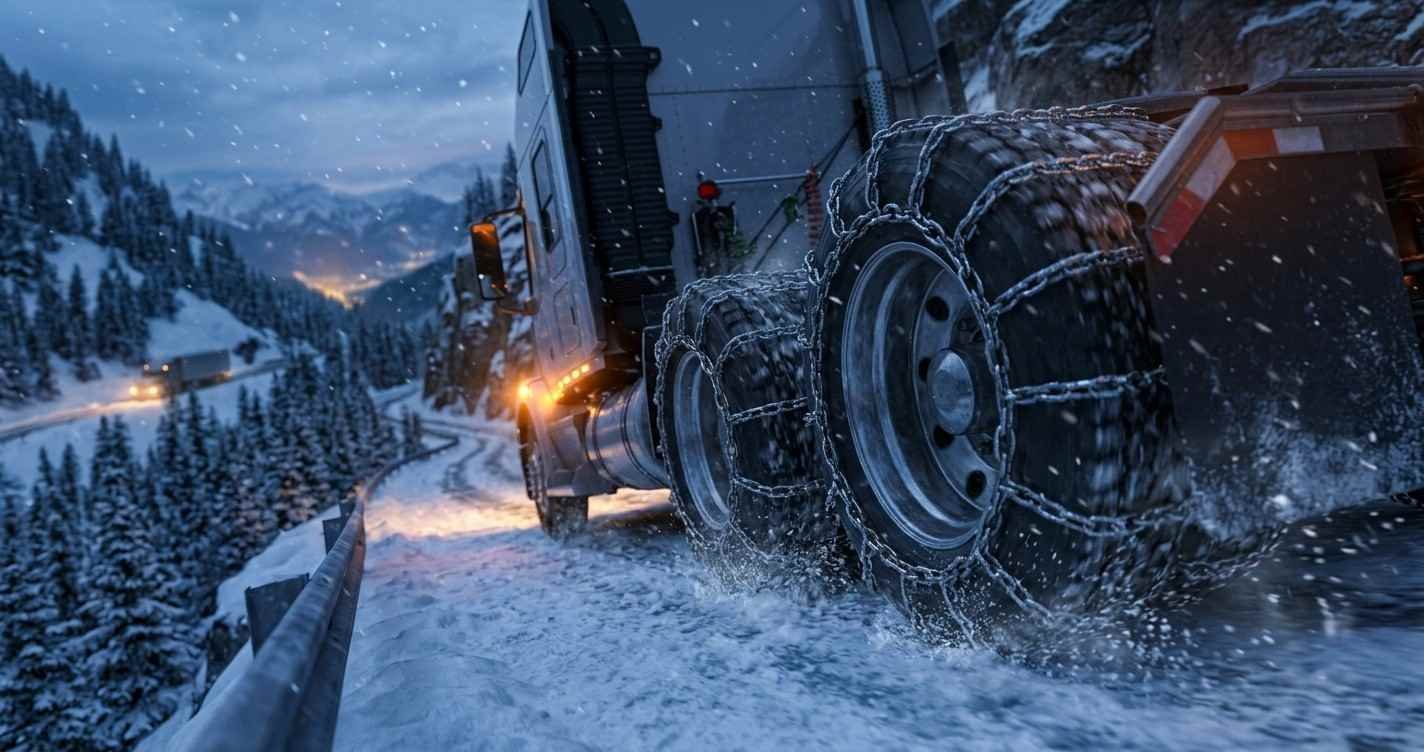
Snow does not care how big a truck is. A loaded tractor-trailer can lose its grip on a mountain grade just as fast as a pickup on an icy driveway, and that is exactly where truck tire chains earn their keep. Chains bite into packed snow and ice, giving drive tires the traction that rubber alone cannot deliver.
This guide from Tire Near Me Hub walks through what chains do, which type suits which truck, how sizing works, what chain laws generally look like, and how to install them step by step. It also covers price, where to buy, and the mistakes that destroy chains (and sometimes fenders).
What are truck tire chains? Truck tire chains are metal link or cable traction devices that wrap around a truck’s drive tires to grip snow and ice. They come in sizes for light trucks and pickups, semi truck dual tires (such as 22.5-inch), and wide-base singles. Most manufacturers advise staying at or below roughly 30 mph while they are on, and many western states require commercial trucks to carry or install them when chain controls are posted.
What Truck Tire Chains Are and How They Work
A set of tire chains is a net of steel links (or steel cable) that sits over the tread and sidewalls. As the tire rolls, the cross members dig into snow and ice and create mechanical grip. Rubber compounds, even good winter ones, simply cannot do this on a sheet of ice.
Why traction matters so much in winter
By the numbers: According to the Federal Highway Administration, around 24% of weather-related vehicle crashes in the U.S. happen on snowy, slushy or icy pavement each year. Over 1,300 people are killed and more than 116,800 injured in those crashes annually, and more than 70% of the nation’s roads sit in snowy regions.
Heavy trucks add another layer of risk. More mass means longer stopping distances, and a trailer can swing out on a grade if the drive axle spins. Chains reduce that wheel spin, which is why regulators in snowy states take them seriously.
The basic parts of a chain set
- Side chains: run around the inner and outer sidewall and hold everything together.
- Cross chains: cross the tread and provide the actual bite.
- Fasteners and cam tighteners: close the set around the tire and take out slack.
- Optional rubber or bungee tensioners: keep the chain snug as it settles.
When Truck Tire Chains Are Required
There is no single federal rule that tells every truck driver when to chain up. Requirements come from individual states, and they change from season to season and even from one mountain pass to the next.
Two common approaches: carry rules and chain controls
- Carry requirements: a few western states require commercial vehicles to carry chains during certain months or on specific highways, even when roads look clear.
- Chain controls: many states post signs or activate “chain-up” areas during storms. When controls are in effect, qualifying trucks must install chains before proceeding.
Colorado: a good example of tiered rules
Colorado is often called one of the strictest states because its commercial rules start early in the season. Its chain law runs in two levels:
- Level 1: single-axle combination commercial vehicles must chain up, while other commercial vehicles need snow tires or chains.
- Level 2: all commercial vehicles with four drive tires must chain them.
Other states drivers watch closely
California, Washington, Oregon, Idaho and Utah all use some form of chain requirements for commercial trucks on mountain routes. Some specify how many drive tires must be chained. Some recognize cable chains or approved automatic systems, while others are more specific. Because the details differ, many drivers carry extra chains.
Speed and fines
Manufacturers generally recommend a maximum of about 30 mph with chains on. Running faster can snap links and damage the truck. Fines for ignoring a chain requirement can run into the hundreds of dollars in some states, and a violation can also block a truck from entering a controlled area entirely.
Types of Truck Tire Chains Compared
Not all chains are built the same. The right choice depends on truck weight, how often chains go on, and how much clearance is available.
| Type | Best for | Pros | Cons |
|---|---|---|---|
| Ladder (link) chains | Semis, work trucks, off-road use | Simple, strong, widely available, often accepted by law | Rougher ride, needs more clearance |
| Diamond / square-link chains | Pickups and light trucks | Smoother ride, more even tread coverage | Costs more, wears faster on bare pavement |
| V-bar chains | Heavy ice, steep grades | Aggressive bite on ice | Harder on tires, rougher on pavement |
| Cable chains | Light trucks with tight clearance | Lightweight, easy to install | Shorter life, may not meet every commercial requirement |
| Automatic (on-board) chains | Fleet tractors | Deploys from the cab, saves time in bad weather | High upfront cost, professional install |
Single vs dual chains
Dual chains wrap two tires on the same side of an axle, which is common on tractors. Single-tire chains fit wide-base singles and individual tires. Using the wrong style for the tire setup is one of the most common buying mistakes.
Truck Tire Chains by Vehicle Type
Pickup truck tire chains and light truck tire chains
Modern pickups often have very little room between tire and suspension. That is why many owner manuals ask for SAE Class S chains, which are designed for restricted clearance. A Class S chain generally needs about 37 mm or less of clearance above the tire and 15 mm or less out from the sidewall.
- Check the owner’s manual for which axle to chain.
- Lifted trucks or large aftermarket tires may need extra clearance checks.
- Popular light truck lines include the Peerless Auto-Trac and Laclede Alpine Sport families.
Not sure what size your truck runs? The Tacoma tire size guide shows how to read the sidewall, and the same method works for any pickup. For heavier-duty rubber, see our guide to 10-ply truck tires.
Semi truck tire chains and heavy duty truck tire chains
Class 8 trucks usually run dual drive tires in 22.5-inch sizes, though wide-base singles are increasingly common. Heavy duty truck tire chains use thicker link, reinforced cross members and cam tighteners to handle weight and torque.
- Match chains to the exact tire size (for example, 11R22.5 or 295/75R22.5).
- Know how many drive tires your state requires you to chain.
- Carry spares of every size you run, plus repair links and tools.
SAE J683 is an information report covering chain clearance for trucks and buses of 10,001 lb GVW and over, which helps fleets plan body and fender room.
Commercial truck tire chains for fleets
Fleet managers weigh cost, driver time and compliance. Options include link sets kept in the cab, automatic systems, and driver training before the first storm. Drivers are often not paid for chain-up time, so many carriers prefer to avoid mountain routes in bad weather rather than chain.
Fork truck tire chains
Pneumatic-tire forklifts working outdoors in snow can use chains made for their specific tire size. Because forklifts are heavy and carry loads up high, chains should fit tightly and be inspected often. Always follow the equipment maker’s manual.
How to Choose the Right Truck Tire Chains
Finding the right set is simple if you follow a few steps in order.
Step-by-step buying checklist
- Read the sidewall. Note the full tire size, such as LT265/70R17 or 11R22.5.
- Check clearance. Pickups: look for Class S requirements. Semis: confirm fender and frame clearance.
- Confirm the legal requirement. Find out whether your route requires chains on one axle or all drive tires.
- Pick the chain style. Ladder for value, diamond for ride quality, V-bar for ice.
- Choose a tightening system. Cam tighteners or rubber tensioners reduce slack.
- Buy spares. Always carry extra cross chains and repair links.
Truck tire chains comparison by use case
| Factor | Pickup / light truck | Semi / heavy duty | Fleet / commercial |
|---|---|---|---|
| Typical tire size | 16–22 inch LT sizes | 22.5 inch duals or wide-base singles | Mixed, depends on fleet |
| Clearance concern | High (often Class S) | Moderate | Varies |
| Common style | Diamond, cable | Ladder or V-bar with cams | Ladder, plus automatic on some tractors |
| Legal pressure | Low, mostly roadside signs | High in mountain states | High, plus company policy |
| Install time (approx.) | 10–20 min | 10 min per set once practiced | Training reduces time |
How to Install Truck Tire Chains Step by Step
Practice once in dry weather. A first-time install in a blizzard is the hard way to learn. Once comfortable, many drivers get a set on in about ten minutes.
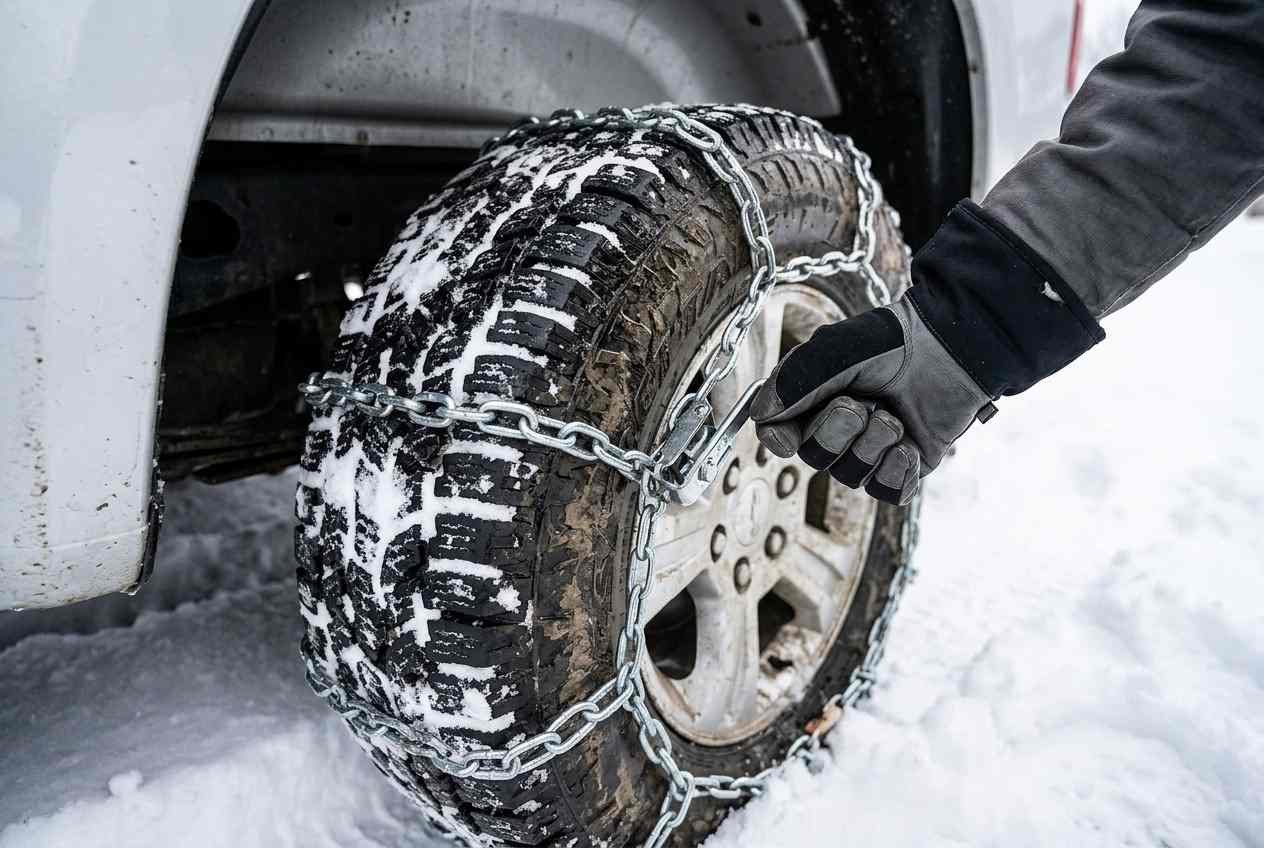
Installing on a semi (drive axle)
- Park safely. Pull onto a level, wide shoulder or a designated chain-up area, away from traffic.
- Lay the chains flat. Remove twists and tangles. Cross-chain hooks should face up and away from the tire.
- Drape over the tire. Center the chain and let the front rest on the ground. Tuck the first cross chains under the tire.
- Roll forward. Move slowly until the fasteners are at about axle height.
- Connect the inside first. Pull it as tight as possible, then fasten the outer side. Use the same number of links on both sides so the chain rotates evenly.
- Tighten. Use cams or tensioners. Leave only about a finger’s width of space under the cross chains.
- Repeat on the other tires as required.
- Test drive. Go slowly for roughly 100–200 yards, stop and re-tighten.
Installing on a pickup
- Lay the set out and drape it over the front of the drive tire.
- Connect the inner fastener behind the tire, then the outer one.
- Drive forward a few feet, stop and tighten again.
- Install tensioners if the chains came without self-tensioning.
Driving With Truck Tire Chains: Tips and Mistakes to Avoid
Practical tips
- Slow down. Stay at or below about 30 mph unless the manufacturer says otherwise.
- Brake early and gently. Chains help traction, not stopping distance on glare ice.
- Re-check after the first mile. Chains settle, and slack is the main cause of breakage.
- Remove on bare pavement. Dry roads chew through chains and can damage the road surface.
Common mistakes
- Buying the wrong tire size or style.
- Skipping a practice install.
- Leaving chains loose.
- Driving too fast.
- Not carrying spares or repair links.
A strong tire foundation also helps. Rotated, evenly worn tires hold chains better, so see the tire rotation and balance cost guide and learn how to get a free tire rotation before winter starts.
Truck Tire Chains Price, Where to Buy and What to Look For
Prices vary widely by brand, tire size and chain style. As a rough guide, budget cable or light-duty sets for pickups can start under about $100, quality diamond or alloy sets often land in the low-to-mid hundreds, and a full set for a semi can run from several hundred dollars into four figures. Treat these as estimates and compare current listings.
Where to buy truck tire chains
- Truck stops and travel centers: convenient in mountain corridors, usually at a premium.
- Tire shops and chain specialists: staff can match sizes. Browse tire services or search by state to find a local shop.
- Farm and rural supply stores: chains for pickups, tractors and utility equipment.
- Online retailers: broad selection and easy size filters, but double-check fit.
Ways to save
- Buy early in the fall, before the first storm drives prices up.
- Watch for promotions such as the Walmart buy 2 get 2 free tire sale if you are also replacing tires.
- Check the latest Tire Rack coupon codes for winter tire savings.
- Explore more tire brands before deciding on a full winter setup.
Own a shop or chain-installation business? You can add it through the business submission page so truck drivers can find you.
Truck Tire Chains vs Snow Tires and Other Options
| Option | Strength | Limit |
|---|---|---|
| Tire chains | Best grip on packed snow and ice | Low speed, install time, wear on bare roads |
| Dedicated snow tires | Better cold-weather braking and handling | Often not enough alone for commercial chain laws |
| All-terrain tires | Good year-round mix | Less ice grip than chains |
| Automatic chain systems | Fast deployment from the cab | Cost and specialist installation |
For SUV and light-truck owners comparing rubber options, read the guide to best snow tires for SUV. Off-road drivers can also look at the Mickey Thompson Baja Boss A/T tire or browse best all-terrain tires.
Care, Inspection and Storage
- Rinse and dry chains after use to slow rust.
- Inspect every link, especially near the fasteners, for stretching or cracks.
- Replace worn cross chains before they fail on the road.
- Store in a labeled bag or box with their tools, so they untangle quickly next winter.
- Check tire pressure and load rating before the season. See the tire pressure gauge guide.
Truck Tire Chains FAQs
How many truck tire chains do I need for a semi?
It depends on state rules. Some require chains on at least one drive axle, others on four drive tires or more. Many drivers carry enough for every drive tire plus spare cross chains so they are covered anywhere.
How fast can you drive with truck tire chains on?
Most manufacturers and many state guides recommend staying under about 30 mph. Higher speeds raise the chance of breakage and vehicle damage.
What size truck tire chains do I need?
Match the chains to the full tire size on the sidewall, such as 11R22.5 for many semi tires or LT265/70R17 for a pickup. Then confirm clearance, since many pickups require SAE Class S chains.
Can I use cable chains on a commercial truck?
Sometimes, but not always. Cable chains are lighter and easier to fit, yet some states have stricter commercial requirements. Check your state DOT before relying on them.
Do truck tire chains damage tires or roads?
Properly sized and tightened chains used on snow or ice cause little harm. Driving on dry pavement, running loose chains or speeding can damage tires, trucks and road surfaces, so remove them when conditions improve.
Conclusion
Truck tire chains are one of the cheapest ways to turn a stuck truck into a moving one. The key is matching the right type and size to the vehicle, understanding the chain rules along the route, and practicing the install before the weather forces the issue.
Pickup drivers should focus on Class S clearance and a snug, self-tensioning fit. Semi and fleet drivers should know their state requirements, carry spares and keep speed low. Whatever the truck, healthy tires make chains work better, so keep them inflated, rotated and inspected. For more help, explore the Tire Near Me Hub blog or find a local shop in the states directory.