Airless Tire: How It Works, Real Options, Pros & Cons (2026 Guide)
An airless tire (also called a non-pneumatic tire, or NPT) carries a vehicle’s weight with flexible spokes, a web or a solid polymer instead of pressurized air. Because there is no air to lose, an airless tire cannot go flat. Airless tires are already sold for lawn mowers, bikes, scooters and industrial equipment, but no airless tire for passenger cars is on sale to the public yet.
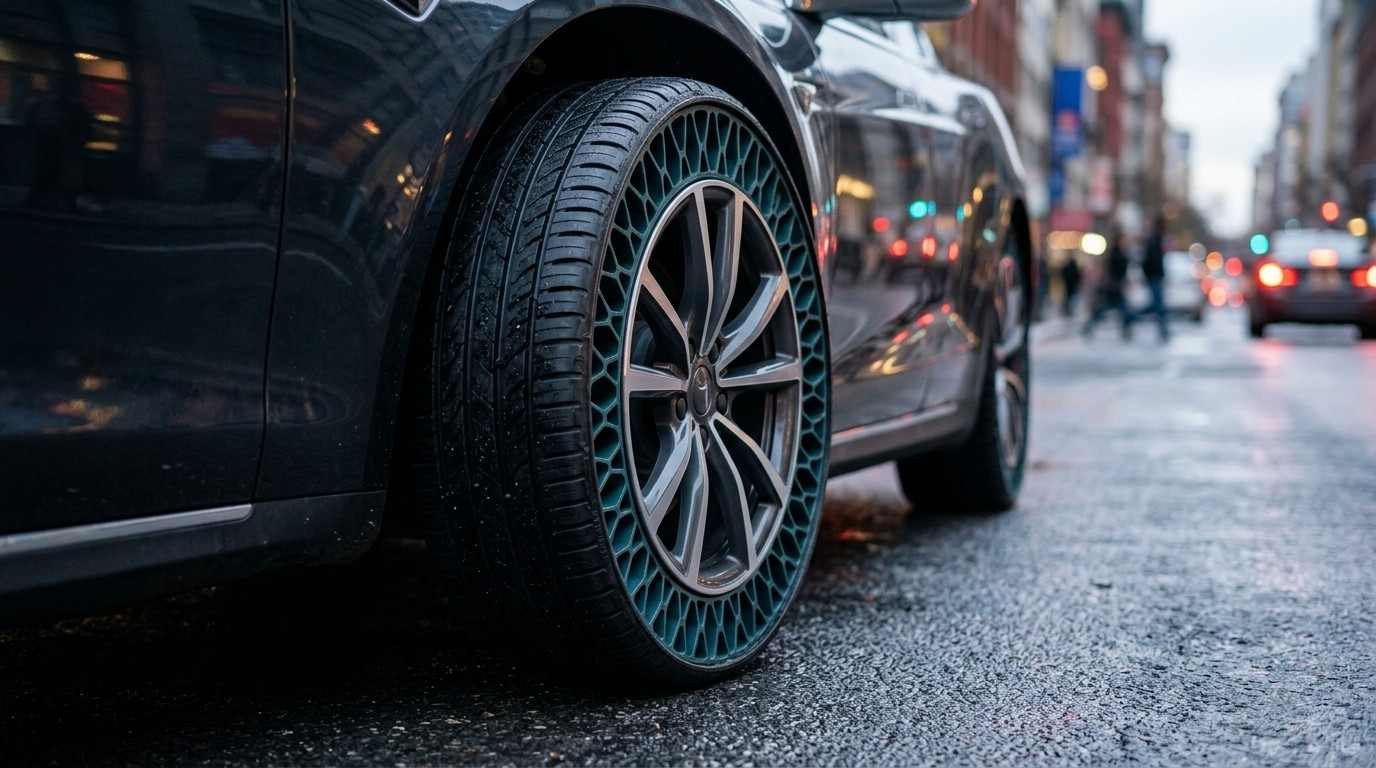
Few people enjoy changing a flat on the shoulder of a busy road. That frustration is the reason airless tire technology keeps returning to the headlines. The idea sounds simple: remove the air and the flat disappears. The engineering, however, is far harder than it looks.
This guide explains what an airless tire is, how the design works, what Michelin, Goodyear, Tannus, Carlstar and others actually offer, and why drivers still cannot buy a set for the family car. It also covers pricing, pros and cons, and practical tips for anyone shopping for flat-free tires today.
What Is an Airless Tire?
An airless tire is a wheel-and-tire system that supports load through its own structure. Instead of a rubber shell holding compressed air, the load travels through engineered spokes, a honeycomb web, a foam or a solid polyurethane body. Engineers call the category non-pneumatic because “pneumatic” refers to air-filled tires, the type invented by John Boyd Dunlop in 1888 and still used on almost every car today.
The appeal is easy to understand. Punctures, blowouts and slow leaks are among the most common reasons tires are retired early, and Michelin has estimated that around 200 million tires are scrapped prematurely every year worldwide because of damage or poor pressure upkeep.
Airless Tire vs. Pneumatic Tire vs. Solid Tire
The terms are often mixed up, so the differences are worth spelling out.
| Feature | Pneumatic (regular) | Solid / foam-filled | Modern airless (spoke or web) |
|---|---|---|---|
| Carries load with | Compressed air | Solid rubber or foam | Engineered spokes or web |
| Can go flat | Yes | No | No |
| Ride comfort | Excellent | Often harsh | Good, design-dependent |
| Weight | Light | Heavy | Moderate |
| Pressure checks | Required | None | None |
| Typical use today | Cars, trucks, bikes | Carts, mowers, industrial | Mowers, bikes, delivery fleets, prototypes |
How Does an Airless Tire Work?
A regular tire behaves like a pressurized balloon wrapped in reinforced rubber. An airless tire behaves more like a carefully tuned spring. Its geometry, not air, decides how stiff or soft the ride feels.
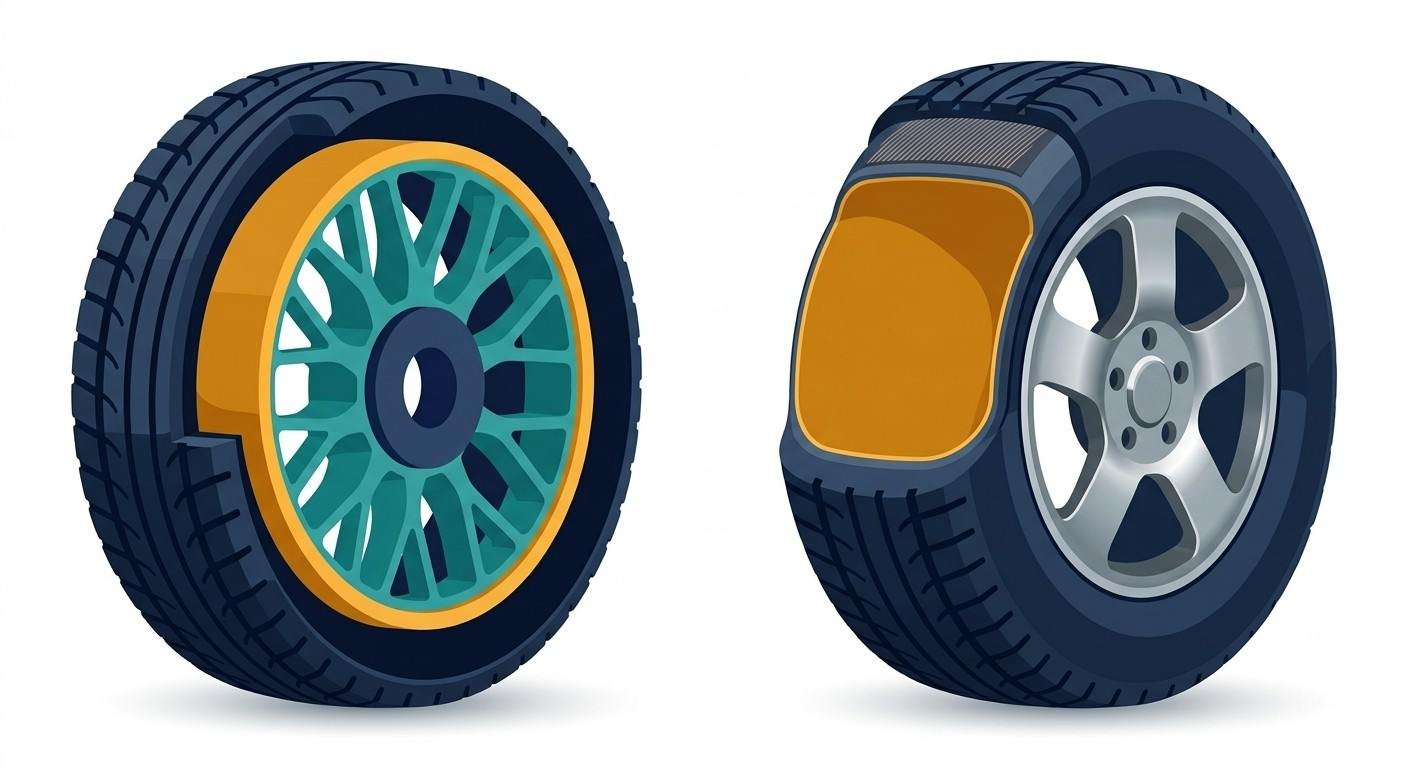
The Main Parts of an Airless Tire
- Hub or wheel: the rigid center that bolts to the vehicle.
- Spokes or web: flexible members that bend under load and spring back. In Michelin’s Uptis, these are made from a resin-embedded fiberglass composite.
- Shear band or ring: a reinforced outer layer that spreads the load across the contact patch.
- Tread: the rubber surface that grips the road, similar to a conventional tire.
Why the Spokes Matter
When the vehicle rolls, the spokes at the bottom compress and the ring above carries much of the load in tension. As each section rotates away from the road, it springs back to shape. Spoke shape, thickness and material decide how much shock the tire absorbs, which is why airless tire design is such an active research field.
Good to know: Michelin has said that at higher speeds the resin spokes of its Uptis flex thousands of times per minute. Heat, noise and fatigue at speed are exactly the problems that have slowed airless tires on highways.
A Short History of Airless Tires
- 1888: Dunlop patents the air-filled tire, setting the standard for the next century.
- Early 1970s: NASA’s Apollo lunar rovers roll on woven wire-mesh wheels, an early airless success in a place where punctures were unthinkable.
- 2005: Michelin shows the Tweel, a combined tire and wheel with polyurethane spokes.
- 2012: Tweel goes on sale for low-speed machines such as skid steers and mowers.
- 2019: Michelin and General Motors unveil the Uptis prototype for passenger cars.
- 2020s: Real-world trials move onto public roads, mainly with commercial fleets.
Michelin Airless Tire: Tweel and Uptis
Michelin is the company most people think of when they search for an airless tire, and for good reason. It is the only major manufacturer that both sells a commercial airless product and runs a long public-road trial for a car-oriented design.
Michelin Tweel
The Tweel is a single unit that merges the tire and wheel. It is sold for slow equipment, including compact loaders and some zero-turn mowers, where puncture downtime costs real money. It is not designed for highway speed.
Michelin Uptis (Unique Puncture-proof Tire System)
The Michelin Uptis is the passenger-car concept behind most “Michelin airless tire” searches. Michelin unveiled it in 2019 with General Motors, with an original target of introducing it on passenger models as early as 2024. That date has passed without a consumer launch.
Recent French press reports from mid-2026 describe the Uptis running on delivery vans for fleets including DHL and La Poste. According to those reports, Michelin counts it as the only airless tire from the group operating in commercial road conditions, with close to 3 million kilometers covered on public roads since 2020.
Important: A Michelin Uptis tire cannot be bought at a tire shop today. Any listing claiming to sell Uptis tires to individual drivers should be treated with caution.
Other Airless Tire Brands to Know
Michelin is not alone. Several manufacturers sell flat-free tires for small vehicles or show concepts for cars. The table below summarizes what is actually available versus what remains a prototype.
| Brand | What it offers | Status for everyday drivers |
|---|---|---|
| Michelin | Tweel (commercial), Uptis (car prototype) | Tweel on sale for slow equipment; Uptis in fleet trials |
| Goodyear | Airless concepts for cars and urban mobility | Concept stage |
| Bridgestone | Air Free concept | Concept stage for cars |
| Hankook | iFlex airless concept | Concept stage |
| Tannus | Airless tires for bikes, scooters, wheelchairs and equipment | On sale |
| Carlstar | Lawn, garden, ATV and trailer tires, including flat-free options | On sale for small equipment |
| Kenda | Puncture-resistant and flat-free tires for small vehicles | On sale for select categories |
Goodyear Airless Tire
Goodyear has shown several airless and non-pneumatic concepts, some using 3D-printed structures and sustainable materials. They remain concepts rather than retail products. Readers who want a current, real-world Goodyear option can read the Goodyear Assurance tire guide.
Tannus Airless Tires
Tannus focuses on airless tires that real customers can order now. Its range targets bicycles, e-scooters, wheelchairs and light equipment. Searchers often look up lines by name, such as Tannus Shield, Razorblade or Portal Hard. Specifications change, so the official Tannus airless page is the best place to confirm sizes and fit.
Carlstar Airless Tires
Carlstar, the group behind the former Carlisle-branded tires, is best known for lawn and garden, ATV, industrial, agricultural and trailer tires. Its airless and flat-free offerings serve mainly small equipment. Pricing is size-specific, so buyers should check the exact dimension printed on the sidewall before ordering.
Airless Tire for Cars: Can Drivers Buy Them Yet?
Not yet. Airless tires for cars face a short list of stubborn engineering and regulatory hurdles.
- Heat at speed: Flexing polymer spokes generate heat, which limits sustained highway speed.
- Noise and vibration: Open spoke structures can hum, and a car buyer expects near-silence.
- Weight: A tire that carries load structurally can weigh more than an air-filled equivalent, which hurts efficiency and handling.
- Certification: Safety rules were written around inflatable tires, so new designs need extensive testing and approval.
- Cost and tooling: Production lines, mounting machines and technician training all need to change.
As Michelin’s own engineers have put it, airless tire technology is new in design, production and approval, so the company has to learn each of those areas from scratch. Shops need to be ready too: standard tire machines and balancing practices were built for inflatable tires.
Tip for current car owners: While airless technology matures, the best protection against flats is routine care. Rotation, correct inflation and age checks go a long way. The guides on free tire rotation and how to read tire date codes cover the basics.
Airless Tire Options for Lawn Mowers, Bikes and Scooters
Airless Tire for Lawn Mower
Lawn equipment is where flat-free tires make the most sense today. Mowers move slowly, carry modest weight and sit unused for months, which is when air-filled tires slowly leak. A flat-free replacement removes the recurring “mower won’t start because the tire is flat” problem.
Standard turf tires from major brands in common sizes were listed from roughly $30 to well over $130 each at large online retailers during research for this guide, and flat-free versions typically cost more. Prices change often, so current listings should always be compared.
- Match the size printed on the sidewall, such as 15×6.00-6 or 20×10.00-8.
- Check the wheel’s bore and hub width, since some flat-free designs are sold as complete wheel assemblies.
- Choose a turf tread for lawns and a deeper tread for slopes or wet ground.
Airless Tire for Bike
Airless bike tires appeal to commuters and delivery riders who cannot afford a roadside repair. The trade-off is usually a firmer ride and extra weight compared with a lightweight inflatable tire. Riders considering the switch should confirm the tire width against their rim and frame clearance first.
Scooters, Wheelchairs and Utility Carts
These low-speed uses are ideal for airless designs, since speed, heat and noise are minor concerns. Many e-scooter riders choose flat-free tires purely to avoid mid-commute punctures.
Airless Tire Pros and Cons
Advantages
- No punctures, blowouts or slow leaks
- No pressure checks or inflators needed
- Potentially fewer tires scrapped early
- No spare tire required in future car designs
- Consistent shape, which supports even wear
Disadvantages
- Not available for passenger cars yet
- Can be heavier and firmer than air-filled tires
- Heat and noise at higher speeds
- Higher upfront price in many categories
- Limited sizes and fewer shops that can service them
Airless Tire Price: What to Expect
There is no consumer price for an airless car tire because none is sold. Michelin has not published a retail price for the Uptis. For categories that do exist, price depends on size, construction and brand.
| Category | Availability | Price outlook |
|---|---|---|
| Passenger car (Uptis and similar) | Not for sale to the public | No retail price yet |
| Lawn mower and garden | On sale | Usually above comparable air-filled tires |
| Bike and scooter | On sale | Often above standard inflatable tires |
| Industrial and skid steer (Tweel type) | On sale through dealers | Quote-based, higher than standard |
Shoppers watching tire budgets can lower the cost of regular tires through promotions. Current offers are collected in the guides on the Walmart tire sale, Tire Rack coupon codes, Mavis tire coupons and the Sam’s Club tire center. Financing options are covered in the Tire Plus credit card guide.
Airless Tire Design: What Engineers Are Working On
Spoke Geometry
Honeycomb, chevron and lattice patterns each distribute load differently. Researchers tune them to balance comfort, durability and noise.
Materials
Polyurethane, thermoplastic elastomers and glass-fiber composites are common. Some makers also test recycled and bio-based materials, in line with sustainability goals.
3D Printing
Additive manufacturing allows complex spoke shapes that are hard to mold conventionally. It remains a prototype and low-volume method for now.
Integration With EVs and Autonomy
Electric and self-driving vehicles favor low-maintenance parts, which is why Michelin and GM originally targeted the Uptis at electric platforms such as the Chevrolet Bolt EV.
Practical Tips for Shoppers and Owners
- Check the use case first. Airless suits slow, light-duty equipment best today.
- Confirm exact size and rim fit before ordering any flat-free tire.
- Buy from the manufacturer or an authorized dealer to avoid counterfeit or mislabeled products.
- Keep regular tires in top shape. For trucks, see truck tire chains, Tacoma tire sizes and the Mickey Thompson Baja Boss A/T.
- Maintain correct pressure on air-filled tires. A reliable tool such as the Milwaukee M18 tire inflator helps.
- Budget for service. Typical shop costs appear in the tire rotation and balance cost guide.
- For performance cars, the Pirelli P Zero is a useful benchmark for what conventional tires still do better than any airless design.
Explore TireNearMeHub
Related Tire Guides
- Mickey Thompson Baja Boss A/T Tire
- Walmart Tire Sale: Buy 2 Get 2 Free
- Tire Rack Coupon Code
- Free Tire Rotation
- Tire Rotation and Balance Cost
- Tacoma Tire Size
- Milwaukee Tire Inflator M18
- Truck Tire Chains
- Goodyear Assurance Tire
- How to Read Tire Date Codes
- Sam’s Club Tire Center
- Pirelli P Zero Tire
- Tire Plus Credit Card
- Mavis Tire Coupons
Further reading from trusted sources: Michelin’s airless tire technology page, the Airless tire overview on Wikipedia and NHTSA tire safety information.
Airless Tire FAQs
What is an airless tire?
An airless tire is a non-pneumatic tire that supports a vehicle with flexible spokes, a web or solid polymer rather than compressed air. It cannot be punctured or deflated, which removes flats and the need for pressure checks.
Can I buy a Michelin airless tire for my car?
Not yet. The Michelin Uptis is still in trials, mostly with commercial fleets, and has no public retail launch. Michelin does sell the Tweel airless wheel, but only for low-speed equipment.
How much does an airless tire cost?
Car versions have no retail price because none is sold. Airless tires for lawn mowers, bikes and scooters are available, and they usually cost more than comparable air-filled tires. Prices vary by size and brand, so current listings should be checked.
Are airless tires better than regular tires?
They are better at avoiding flats and maintenance, but regular tires still lead on ride comfort, weight, noise and cost for cars. Airless designs make the most sense today on slow, light-duty equipment.
Can airless tires be used on a lawn mower or bike?
Yes. Flat-free options from brands such as Tannus and Carlstar exist for lawn equipment, bikes and scooters. Buyers should match the exact size, rim width and intended use before ordering.
Conclusion: Is the Airless Tire Ready for Everyday Driving?
The airless tire is real, proven and useful, just not yet on the family car. Tannus and Carlstar already offer flat-free solutions for bikes, scooters and lawn equipment. Michelin’s Tweel serves slow industrial machines, while the Michelin Uptis is moving through fleet trials toward an eventual passenger-car launch.
Until the remaining challenges of heat, noise, weight, cost and certification are solved, air-filled tires will remain the standard for cars. Careful maintenance, smart shopping and regular checks still protect drivers best. For tire shops, prices and guides, visit the TireNearMeHub blog or browse tire brands.