How Do Tire Pressure Sensors Work? The Complete Guide to TPMS
Direct vs. indirect systems, warning light meanings, rotation tips, and simple fixes
Tire pressure sensors work by measuring the air pressure inside each tire and reporting it to the car’s computer. Direct systems use a battery-powered sensor in each wheel that sends a radio signal. Indirect systems use the ABS wheel-speed sensors to spot a tire that spins faster because it is low on air. When pressure falls about 25% below the recommended level, the dashboard light turns on.
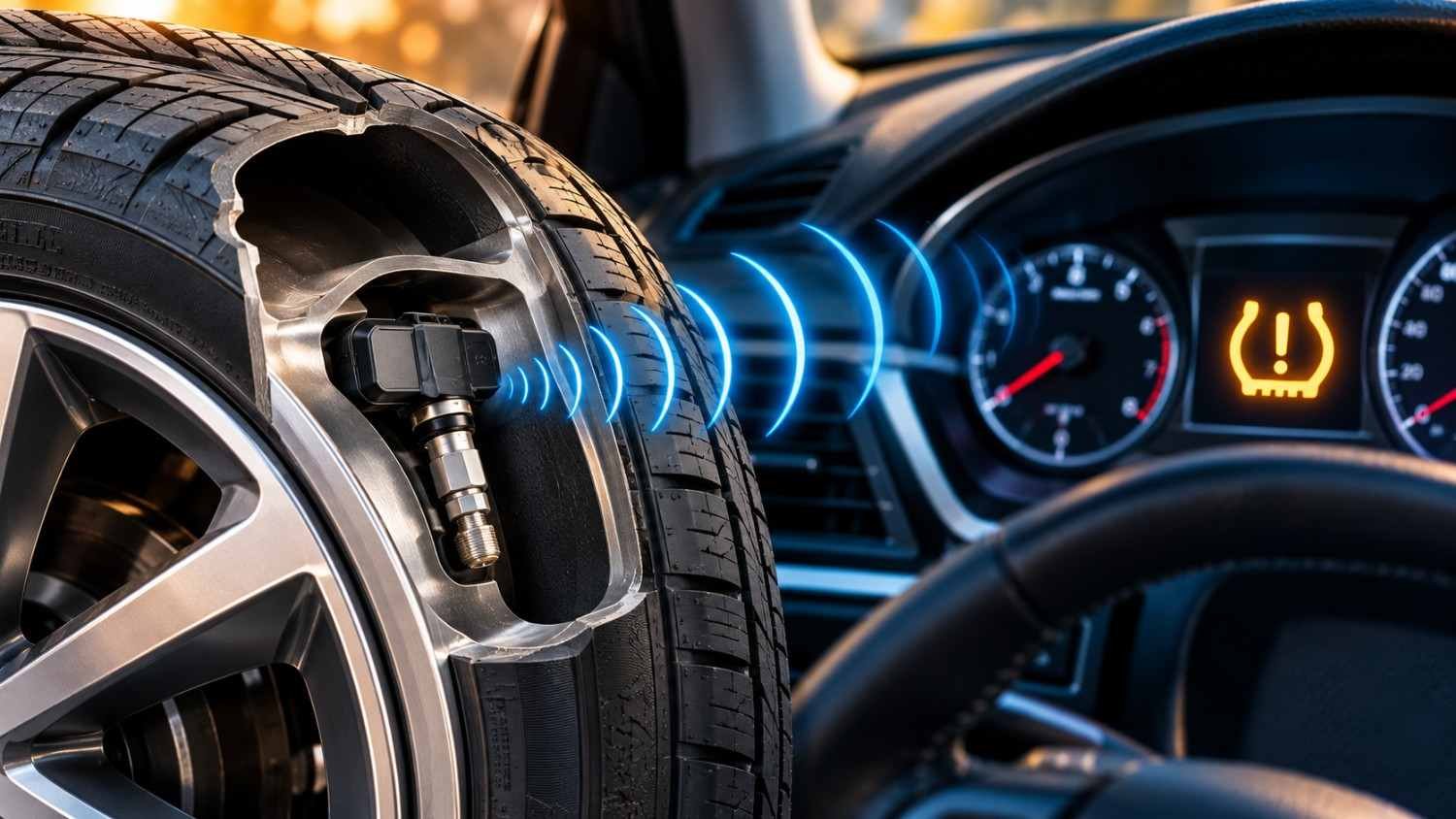
That small yellow horseshoe-shaped light on the dashboard has a big job. It watches four (sometimes five) tires around the clock, and it speaks up before a slow leak turns into a blowout. Yet many drivers still ask the same thing: how do tire pressure sensors work, and why do they sometimes act up?
This guide explains the technology in plain language. It covers the two types of tire pressure monitoring systems (TPMS), what each warning light pattern means, what happens when tires are rotated, and what to expect on popular vehicles like Toyota and Jeep. It also includes real-world costs and a simple reset routine.
What Is a Tire Pressure Monitoring System (TPMS)?
A tire pressure monitoring system is an electronic safety feature that tracks tire inflation and alerts the driver when it drops too low. Most people simply call the parts “tire pressure sensors,” and the dashboard symbol the “TPMS light.”
Why Cars Have TPMS
In the United States, the TREAD Act was passed in 2000 after a string of rollover crashes linked to underinflated tires. It required automakers to add tire pressure monitoring to new vehicles. The requirement was phased in, and by the 2008 model year (with the 2007 model year largely covered) essentially every new passenger car and light truck under 10,000 pounds had it.
The federal rule (FMVSS 138) says the warning must appear when one or more tires fall 25% below the recommended cold pressure, and the system must detect it within about 20 minutes of driving. For a tire that should be at 35 PSI, that means the light comes on at roughly 26 PSI or lower.
Why Tire Pressure Matters
- Safety: Underinflated tires overheat, wear unevenly, and take longer to stop.
- Fuel economy: The U.S. Department of Energy says keeping tires properly inflated can improve gas mileage by up to 3%.
- Tire life: Low pressure wears out the outer edges of the tread early, which means buying new tires sooner.
How Do Tire Pressure Sensors Work? Step by Step
The exact hardware depends on the system type, but the basic process is the same on almost every car:
- Measure. The system measures pressure directly (a sensor inside the tire) or estimates it indirectly (wheel-speed data).
- Transmit. A direct sensor sends a short radio signal. An indirect system skips this step because the ABS module already has the data.
- Receive. The car’s receiver or body control module collects the signal and matches it to a wheel position.
- Compare. The computer compares each reading to the manufacturer’s recommended pressure.
- Alert. If a tire drops below the threshold, the TPMS light appears. Many newer cars also show the exact PSI for each tire on the display.
Direct TPMS: Sensors Inside the Wheel
Direct TPMS is the most common system in the U.S. Each wheel carries a small electronic module that reads the air pressure itself.
What Is Inside a Direct Sensor?
- A pressure transducer that measures air pressure
- A temperature sensor (pressure changes with heat)
- A motion or acceleration sensor that wakes it up when the wheel turns
- A tiny radio transmitter
- A sealed lithium battery
How the Signal Travels
The sensor sends a short burst of data, usually on a 315 MHz or 433 MHz radio frequency, and each sensor carries a unique ID. The car’s receiver recognizes that ID and knows which tire is reporting. To save battery, many sensors sleep while the car is parked and transmit only after the vehicle starts moving.
Sensor Locations
Valve-stem mounted
The sensor is built into the valve stem and is the most common design on passenger cars.
Banded or strapped
The sensor is strapped to the inside of the wheel barrel. This design is more common on some trucks and specialty wheels.
Battery Life
The sensor battery typically lasts around 5 to 10 years, depending on driving habits and climate. The battery is sealed, so when it dies the whole sensor is replaced. This is why sensors often fail around the same time on all four wheels.
Indirect TPMS: Using the ABS Wheel-Speed Sensors
Indirect TPMS has no pressure sensor in the tire. Instead, it uses the same wheel-speed sensors that run the anti-lock braking system.
The logic is simple. A tire with low pressure has a slightly smaller rolling diameter, so it spins a little faster than the others to cover the same distance. The computer notices the difference and turns on the light.
It is cheaper to build and has no batteries to replace. The trade-off is accuracy. It cannot show an exact PSI, and it can miss a situation where all four tires lose air evenly. It also must be reset after tires are inflated, rotated, or replaced, so it knows what “normal” looks like.
Direct vs. Indirect TPMS: Comparison Table
| Feature | Direct TPMS | Indirect TPMS |
|---|---|---|
| How it measures | Pressure sensor in each wheel | ABS wheel-speed comparison |
| Shows exact PSI | Yes (on most cars) | No |
| Detects all four tires low | Yes | Often not reliably |
| Battery | Yes, 5–10 years | None |
| Reset needed after rotation | Sometimes (relearn) | Usually yes |
| Repair cost | Higher | Lower |
What the TPMS Warning Light Means
The light tells two different stories depending on how it behaves.
| Light Behavior | Meaning | What to Do |
|---|---|---|
| Solid light | One or more tires are low | Check all four tires with a gauge and inflate to the door-jamb placard pressure |
| Flashes for about a minute, then stays on | System fault (bad sensor, dead battery, receiver issue) | Have the system scanned at a shop |
| Comes on in cold weather | Air contracted overnight | Top off tires; the light usually clears after driving |
| Stays on after inflation | System needs a reset or relearn | Follow the reset steps below |
How Do Tire Pressure Sensors Work When You Rotate Tires?
This is one of the most common questions, and the answer depends on the system.
- Direct TPMS: The sensors move with the wheels. After a rotation, the car must learn their new positions, or the display may show the wrong tire as low. Some cars relearn automatically after a short drive. Others need a scan tool or a button-based procedure.
- Indirect TPMS: The system is reset after rotation so it can set a new baseline for each wheel.
Rotation is part of normal maintenance, so it is worth knowing how it affects the sensors. Drivers of all-wheel-drive vehicles can read the AWD tire rotation guide for the best pattern, and anyone comparing prices can check the Walmart tire rotation cost breakdown.
How Tire Pressure Sensors Work on a Car, a Toyota, and a Jeep
On a Typical Car
Most modern cars use direct TPMS with valve-stem sensors. Pressure readings appear on the instrument cluster, or the car simply shows the warning light. The recommended pressure is on the placard inside the driver’s door jamb, not on the tire sidewall. The sidewall number is the tire’s maximum, which is a different thing. For more on what those sidewall markings mean, see the tire load rating guide.
On a Toyota
Many Toyota models use direct sensors and have a TPMS reset button, usually under the dash or near the steering column. A common routine is to inflate all tires to the placard pressure, then use the reset button as described in the owner’s manual. Some Toyotas also relearn automatically after driving for a while at moderate speed. Procedures vary by model year, so the owner’s manual is the final word.
On a Jeep
Many Jeep models display individual tire pressures in the driver information screen, which makes it easy to spot which tire is low. Off-road setups matter here. Aired-down tires on the trail will trigger the light, and larger aftermarket wheels and tires may need sensors transferred or reprogrammed. Owners fitting all-terrain tires can look at options like the Nitto Ridge Grappler or the Falken Wildpeak A/T4W, and should ask the installer to handle the sensors during mounting.
Common TPMS Problems and How to Fix Them
Light Is On but Tires Look Fine
- Check all four tires with a gauge, including the spare if it has a sensor
- Inflate to the door-jamb pressure when tires are cold
- Drive for 10 to 20 minutes to let the system update
Light Flashes Then Stays On
- A sensor battery may be dead
- A sensor may be damaged from a tire change
- Radio interference or a receiver fault is possible
Simple Reset Routine (General)
- Let the tires cool, then inflate each one to the recommended PSI.
- Turn the ignition to the “on” position without starting the engine.
- Press and hold the TPMS reset button until the light blinks, if your car has one.
- Start the car and drive for 10 to 20 minutes.
- If the light stays on, visit a shop for a scan.
Cold weather is a frequent cause. As a rule of thumb, tire pressure drops about 1 PSI for every 10°F drop in temperature. That is why the light often appears on the first cold morning of the season.
How Much Does TPMS Sensor Replacement Cost?
Prices vary by vehicle, sensor brand, and shop, so treat these as typical ranges rather than quotes.
| Service | Typical Range |
|---|---|
| Sensor part (each) | About $40–$120 |
| Installed with programming (each) | About $80–$250 |
| Sensor relearn / reset | Often free to about $30 at many shops |
| Service kit (valve core, nut, seal) | About $5–$15 per wheel |
The smartest time to replace an aging sensor is when new tires are being installed, because the tire is already off the wheel. That keeps labor low. For a look at what mounting and balancing typically costs, read the tire mount and balance cost guide. Shoppers watching for deals can also check the Costco Michelin tire sale page.
Pro Tips to Keep Your Tire Pressure Sensors Healthy
- Check pressure monthly with a gauge, ideally when tires are cold.
- Replace the valve stem service kit whenever new tires are installed.
- Do not ignore a flashing light. It means the system itself needs attention.
- Use shops that have TPMS tools. Not every tire shop programs every sensor type.
- Do not rely on the sidewall number. Use the door-jamb placard.
- Keep winter in mind. Add air as temperatures fall.
Where to Get TPMS Service
Most national and local tire shops can test, reset, and replace sensors. If something is urgent, the tire shop open today page helps locate a place that is open now. Drivers can also compare Discount Tire hours, learn about Big O Tires, check National Tire and Battery, or see whether a Walmart Tire Center is open on Sundays.
To search by location, visit the states directory, browse tire brands, or explore all tire services. Shop owners can submit a business listing, and readers can find more guides on the Tire Near Me Hub blog.
For official safety guidance, see the NHTSA tire safety page and the U.S. Department of Energy fuel economy tips.
Frequently Asked Questions
1. How do tire pressure sensors work in cars?
Most cars use direct sensors inside each wheel that measure air pressure and send a radio signal to the car’s computer. If a tire is about 25% below the recommended pressure, the TPMS light turns on. Some cars use an indirect system that compares wheel speeds instead.
2. Do tire pressure sensors need to be reset after rotating tires?
Often, yes. Direct systems may need a relearn so the car knows each sensor’s new position, and indirect systems are usually reset to recalibrate. Some vehicles do this automatically after a short drive.
3. How long do tire pressure sensor batteries last?
Typically around 5 to 10 years. The battery is sealed inside the sensor, so the whole sensor is replaced when it fails.
4. Why is my TPMS light on when my tires are fine?
Common causes are cold weather, a slightly low tire you did not notice, a sensor that needs a reset, or a failing sensor. A flashing light that turns solid usually points to a system fault.
5. Can I drive with the tire pressure light on?
Briefly, to reach a safe place to check the tires, yes. But a solid light means a tire may be dangerously low, so check and inflate as soon as possible. A system fault light is less urgent but should still be fixed.
Conclusion
So, how do tire pressure sensors work? Direct systems measure the air inside each tire and transmit it by radio, while indirect systems infer low pressure from wheel speed. Either way, the car compares the reading to the recommended level and lights up when a tire is about 25% low.
Knowing the difference helps with everything from rotations to resets to replacement costs. Check pressure monthly, relearn sensors after rotations, and have a flashing light inspected promptly. For more practical tire guides, browse the blog or return to the Tire Near Me Hub homepage.