AWD Tire Rotation: The Complete Guide to Patterns, Intervals and Charts
Learn the right AWD tire rotation pattern for your vehicle, how often to do it, and how to protect your drivetrain from costly damage.
An AWD tire rotation is one of the cheapest ways to protect a very expensive part of the car. All-wheel-drive vehicles send power to all four wheels, so the four tires have to work as a team. When one pair wears faster than the other, the drivetrain can end up fighting itself.
This guide explains what an AWD tire rotation is, which pattern to use, how often to schedule it, and what changes for popular models like Subaru, Honda, Toyota RAV4 and Tesla Model Y. It also covers 4×4 trucks, directional tires, spare tires and common mistakes.
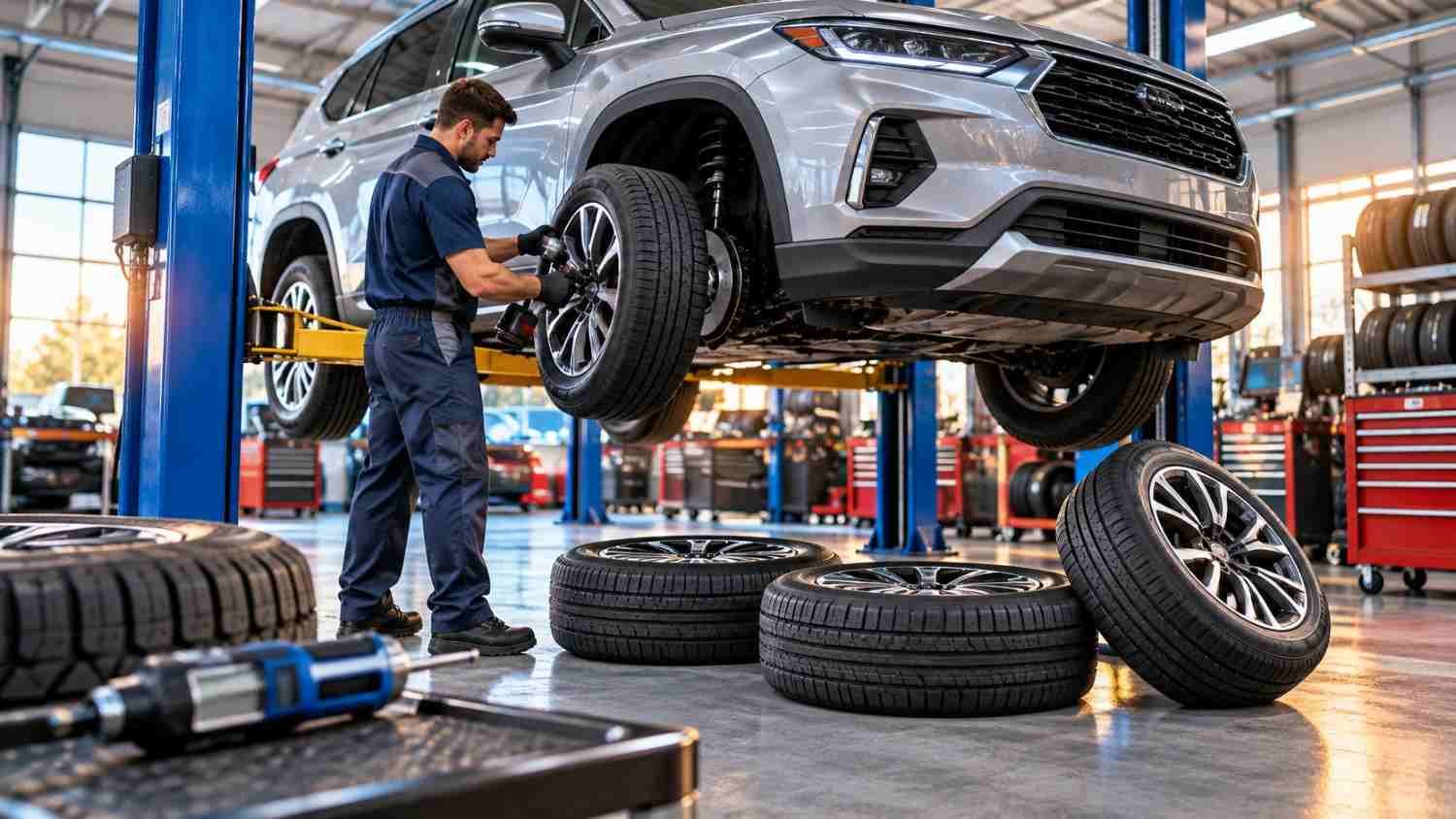
What Is an AWD Tire Rotation?
Tire rotation means moving each tire and wheel to a different position on the vehicle on a regular schedule. The goal is simple: spread wear evenly so all four tires last longer and perform the same way.
On an AWD vehicle, the stakes are higher. Power is shared between the front and rear axles, and the system is designed around four tires with nearly identical rolling circumference. Rotation keeps those circumferences close together.
AWD vs 4WD: does the rotation differ?
The tire industry generally recommends the same X-pattern for both all-wheel-drive and four-wheel-drive vehicles when the tires are non-directional and the same size. The main difference is how the systems work:
- AWD: Runs automatically, usually all the time, and often uses a center differential, clutch pack or electronic coupling.
- 4WD: Usually driver-selected, often with a transfer case and low-range gearing, common on trucks and body-on-frame SUVs.
Either way, mismatched tires can cause drivetrain strain, so the same discipline applies.
Why AWD Vehicles Need Regular Tire Rotation
Front tires handle steering and most of the braking load. Rear tires mostly follow along. Even on an AWD car, that imbalance means the tires in each position wear differently. The Tire Industry Association (TIA) notes that steering scrubs the front tires harder than the rears, which is why rotation is needed at all.
1. It protects the drivetrain
A tire with less tread has a slightly smaller diameter, so it spins slightly faster than a fresher tire on the same vehicle. In an AWD system, that speed difference can force the center differential or coupling to work constantly. Over time, heat and wear can build up. Bridgestone also points out that evenly worn tires lower stress on AWD drive components.
2. It extends tire life
Even wear means you replace all four tires at the same time, instead of two worn tires and two barely used ones. That saves money and keeps handling predictable.
3. It keeps traction consistent
Matched tread depth helps the car brake, corner and grip evenly in rain and snow, which is exactly why many drivers buy AWD in the first place.
4. It may protect your warranty
Some tire warranties require proof of regular rotation. Keep your receipts and note the mileage.
How Often Should You Do an AWD Tire Rotation?
The TIA suggests rotating every 5,000 to 7,000 miles depending on the vehicle. Bridgestone gives a broader range of 5,000 to 8,000 miles or about six months, and recommends 5,000 miles or less for AWD and 4WD trucks, especially with heavy hauling or off-road use.
| Driving situation | Suggested interval | Why |
|---|---|---|
| Normal commuting | 5,000 to 7,000 miles | Matches typical manufacturer guidance and many oil change schedules |
| Frequent towing or heavy loads | Closer to 5,000 miles or less | Added weight speeds up wear |
| Off-road or gravel roads | Closer to 5,000 miles or less | Rough surfaces wear and damage tread faster |
| Electric AWD (for example, Tesla) | Follow the owner’s manual; many drivers choose about 5,000 to 6,000 miles | High torque and vehicle weight increase wear |
| Brand-new tires | First rotation by about 5,000 miles | Deep fresh tread is more prone to uneven wear |
Check tread depth at the same time
Use a tread depth gauge or the classic penny test. In the U.S., 2/32 of an inch is the legal minimum, but many safety experts suggest replacing tires sooner for wet or snowy conditions. On AWD vehicles, many manufacturers also set a limit on how much tread depth can differ between tires, so ask your dealer or consult the manual.
AWD Tire Rotation Patterns (With Diagrams)
The correct pattern depends on four things: drivetrain, tire type (directional or non-directional), whether front and rear tires are the same size, and whether a full-size spare is included.
The X-pattern for AWD (most common)
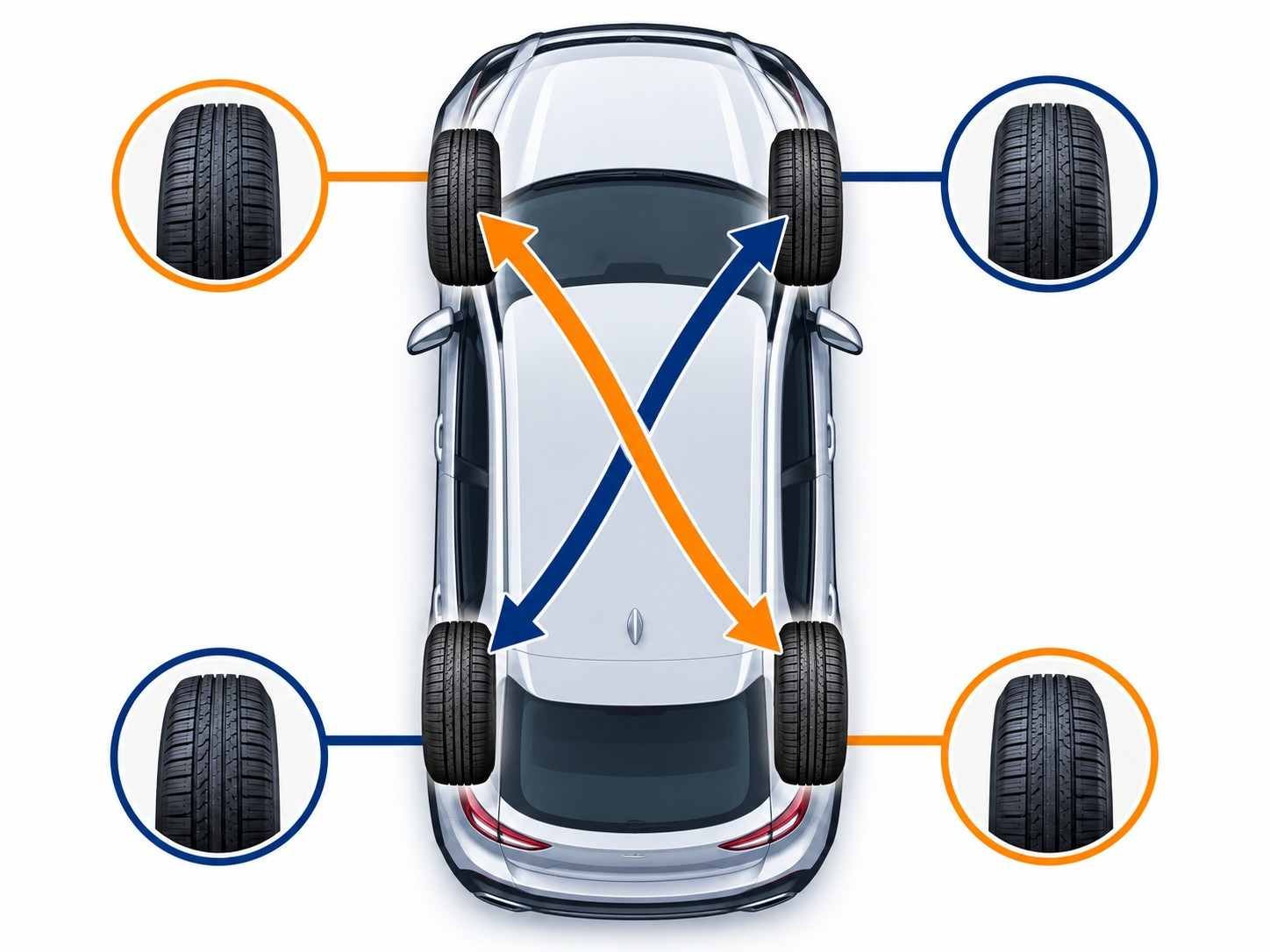
For all-wheel-drive and four-wheel-drive vehicles with non-directional tires of the same size, the TIA recommends a pattern often called the “double X.” Each tire moves to the opposite axle and the opposite side.
Step by step
- Move the front left tire to the rear right.
- Move the front right tire to the rear left.
- Move the rear left tire to the front right.
- Move the rear right tire to the front left.
Rearward cross (common alternative for 4WD trucks)
Some automakers prefer the rearward cross for rear-biased drivetrains and many 4×4 trucks. The rear tires go straight to the front on the same side, and the front tires cross to the opposite sides of the rear axle. The tire industry lists this as the standard pattern for rear-wheel-drive vehicles, and some manuals also use it for 4WD, so follow your manual.
Front-to-back pattern for directional tires
Directional tires have an arrow on the sidewall showing the rolling direction. Unless the tire is remounted on the rim, it must stay on the same side of the vehicle. So the front and rear tires on the same side simply swap places.
Side-to-side pattern for staggered setups
If the front and rear tires are different sizes (common on performance AWD cars), only side-to-side swapping on the same axle is possible. Wear can’t be balanced across axles in this setup, which is why the front and rear tires may need replacing at different times.
Rotating with a full-size spare
If the vehicle carries a matching full-size spare, bringing it into the rotation spreads wear across five tires. Bridgestone notes this is especially valuable on AWD and 4WD vehicles, where small differences stress the drivetrain. If the spare has a sensor, the tire pressure monitoring system may need to relearn positions afterward.
| Pattern | Best for | How it moves |
|---|---|---|
| X-pattern (double X) | AWD and 4WD, non-directional, same-size tires | All tires cross to the opposite axle and side |
| Rearward cross | RWD, and some 4WD trucks per manual | Rear tires go straight forward; front tires cross to rear |
| Forward cross | FWD vehicles | Front tires go straight back; rear tires cross to front |
| Front-to-back | Directional tires | Swap front and rear on the same side |
| Side-to-side | Staggered (different front and rear sizes) | Swap left and right on the same axle |
AWD Tire Rotation Chart: Quick Reference
Use this chart as a quick cheat sheet. When in doubt, the owner’s manual overrides any general rule.
| Current position | Moves to (X-pattern) |
|---|---|
| Front left (FL) | Rear right (RR) |
| Front right (FR) | Rear left (RL) |
| Rear left (RL) | Front right (FR) |
| Rear right (RR) | Front left (FL) |
Because an X-pattern rotation swaps tires in opposite pairs, the same chart works as an AWD tire rotation sequence every time: do the left-front/right-rear swap, then the right-front/left-rear swap.
AWD Tire Rotation by Vehicle: Subaru, Honda, RAV4, Tesla and Trucks
Automakers have their own preferences. The notes below are general guidance. Always confirm in your owner’s manual or with a dealer.
Subaru AWD tire rotation
Subaru’s symmetrical AWD is especially sensitive to tires with different circumferences. Subaru owners are generally advised to rotate about every 6,000 miles or six months, keep all four tires the same brand, model and size, and replace all four together when possible. Many Subaru manuals call for a front-to-back rotation or an X-pattern, so check which one applies to your model year.
Honda AWD (such as CR-V)
Honda’s Maintenance Minder system tells the driver when a rotation is due, so a 2018 Honda CR-V AWD tire rotation is usually scheduled by that reminder rather than a fixed number. If the vehicle uses non-directional tires of equal size, an X-pattern or the pattern in the manual is the usual approach.
Toyota RAV4 AWD
Toyota’s standard maintenance schedule generally pairs a tire rotation with the 5,000-mile service interval. For a Toyota RAV4 AWD, the X-pattern is a common choice for matching tires, and the dealer can confirm what applies to your trim.
Tesla Model Y AWD
Electric AWD cars are heavy and deliver instant torque, which can speed up wear. Tesla publishes its own rotation interval and pattern guidance, so use the owner’s manual and rotate sooner if tread depth differs noticeably between the front and rear axles. Remember that TPMS may need to be checked afterward.
4×4 truck AWD tire rotation pattern
Trucks that run all-terrain or mud-terrain tires wear them quickly, especially when towing or off-roading. For these vehicles, a shorter interval (around 5,000 miles or less) is common, and a full-size spare belongs in the rotation if it matches. Drivers who run aggressive all-terrain tires, such as the Nitto Ridge Grappler tire, often see uneven shoulder wear sooner, so tread checks matter even more.
Common AWD Tire Rotation Mistakes to Avoid
- Replacing only two tires. New tires paired with badly worn ones create a circumference mismatch. If only two must be replaced, ask a technician about shaving the new tires to match, or about the manufacturer’s rules.
- Mixing brands, models or sizes. Different tires wear differently, even if the size matches.
- Ignoring tire pressure. A single low tire has a smaller rolling diameter. A reliable inflator like the Airmoto tire inflator makes monthly pressure checks easy.
- Skipping the torque step. Lug nuts should be tightened to the manufacturer’s specification, ideally in a star pattern, and re-checked after the first drive.
- Using the wrong pattern for directional tires. Swapping them across sides can make them roll the wrong way.
- Forgetting TPMS. Some vehicles need the system to relearn tire positions.
DIY vs Professional AWD Tire Rotation
| Factor | DIY | Professional shop |
|---|---|---|
| Tools needed | Jack stands, torque wrench, lug wrench | Lift, impact tools, calibrated torque equipment |
| Time | Often 45 to 90 minutes for a first-timer | Usually about 15 to 30 minutes for a four-tire rotation |
| Inspection | Only what you notice | Tread depth, pressure, damage and balance checks |
| Safety | Never work under a car held by a jack alone | Professional lifting equipment |
| Cost | Free besides tools | Often free or low-cost with tire purchases |
For most people, a professional rotation is the simplest option. Technicians can also spot sidewall bulges, uneven wear, alignment issues and worn components while the wheels are off.
Where to get it done
Plenty of national and regional chains offer rotations, and many include them free for tires bought from them. Before heading out, check shop schedules. These pages can help:
- Search for a tire shop open today if you need same-day service.
- Confirm the Discount Tire hours before you go.
- Read about Big O Tires and National Tire and Battery for service options.
- Planning a Sunday visit? See whether the Walmart Tire Center is open on Sundays.
- Browse all tire services, or find shops by state.
Signs Your AWD Tires Need Rotating or Replacing
- Visible differences in tread depth between front and rear tires
- Vibration in the steering wheel or seats at highway speed
- Feathered or cupped edges on the tread blocks
- A humming or growling noise that gets louder with speed
- Drivetrain or AWD warning lights (some systems flag mismatched tires)
- The car pulling slightly to one side
If several of these show up together, book an inspection. Compare options in the tire brands section when replacement is due, and remember that AWD usually calls for replacing all four tires at once.
AWD Tire Rotation FAQs
How often should you do an AWD tire rotation?
Most AWD vehicles need a rotation every 5,000 to 7,000 miles, or about every six months. Heavy loads, towing, off-roading and aggressive driving call for shorter intervals. The owner’s manual has the final say.
What is the correct AWD tire rotation pattern?
For non-directional tires of the same size, the X-pattern is the standard: each tire moves to the opposite axle and the opposite side. Directional tires use a front-to-back swap, and staggered setups use side-to-side swaps.
Can you rotate just two tires on an AWD vehicle?
It is not recommended. AWD systems depend on all four tires having nearly the same circumference. Replacing or rotating only two can create a tread-depth difference that strains the drivetrain.
Do AWD cars need more frequent rotation than FWD cars?
Not always more often, but the consequences of skipping it are bigger. Uneven wear on an AWD car can stress the center differential or coupling, so staying on schedule protects expensive parts.
Does a Tesla Model Y AWD need tire rotation?
Yes. Electric AWD vehicles are heavy and deliver instant torque, which can wear tires quickly. Follow the interval in the owner’s manual and rotate sooner if tread depth differs between axles.
Conclusion: Make AWD Tire Rotation a Habit
A proper AWD tire rotation takes under an hour at most shops, yet it protects tires, traction and drivetrain components that cost far more to repair. The essentials are easy to remember:
- Rotate every 5,000 to 7,000 miles, or sooner for towing, off-roading and electric AWD.
- Use the X-pattern for equal-size, non-directional tires, and follow the manual for exceptions.
- Keep all four tires the same brand, model and size, and replace them as a set.
- Check tire pressure monthly and tread depth at every rotation.
Treat rotation as routine maintenance, not an optional extra, and the car will reward the driver with longer tire life and steadier grip in every season.
Need an AWD tire rotation near you?
Explore the Tire Near Me Hub, read more guides on the blog, or submit your tire business to be listed.
Sources and Further Reading
This article is for general information. Always follow your vehicle manufacturer’s instructions and consult a qualified technician for service decisions.