Tire Balancing Cost in 2026: What You Should Really Pay (Shop-by-Shop Prices)
Walmart, Costco, Discount Tire, Firestone, Mavis, Midas, Pep Boys and independent shops compared, plus simple ways to pay less.
Quick answer: Tire balancing cost usually runs $15 to $75 per tire, with most drivers paying $15 to $30 per tire (roughly $60 to $120 for a full set of four) at a chain or independent shop. Prices rise for large truck tires, alloy wheels, and premium “road force” balancing. Many retailers include balancing for free, or at a discount, when you buy tires from them.
A steering wheel that shakes at 60 mph is one of the most common reasons drivers walk into a tire shop. More often than not, the fix is simple: balance the tires. The harder question is what the service should cost, because quotes can look very different from one shop to the next.
This guide explains how much tire balancing costs, what pushes the price up or down, and how big names compare. It also covers how to avoid paying for the same service twice. Prices below are typical ranges based on common retailer pricing and can change by location, vehicle, and promotion, so always confirm with your local shop before you book.
What Is Tire Balancing (and Why Does It Cost Money)?
Tire balancing corrects uneven weight distribution in a wheel and tire assembly. No tire is perfectly uniform. Tiny differences in rubber, steel belts, and the valve stem create heavy spots. At highway speed, those heavy spots cause the wheel to hop slightly, which you feel as vibration.
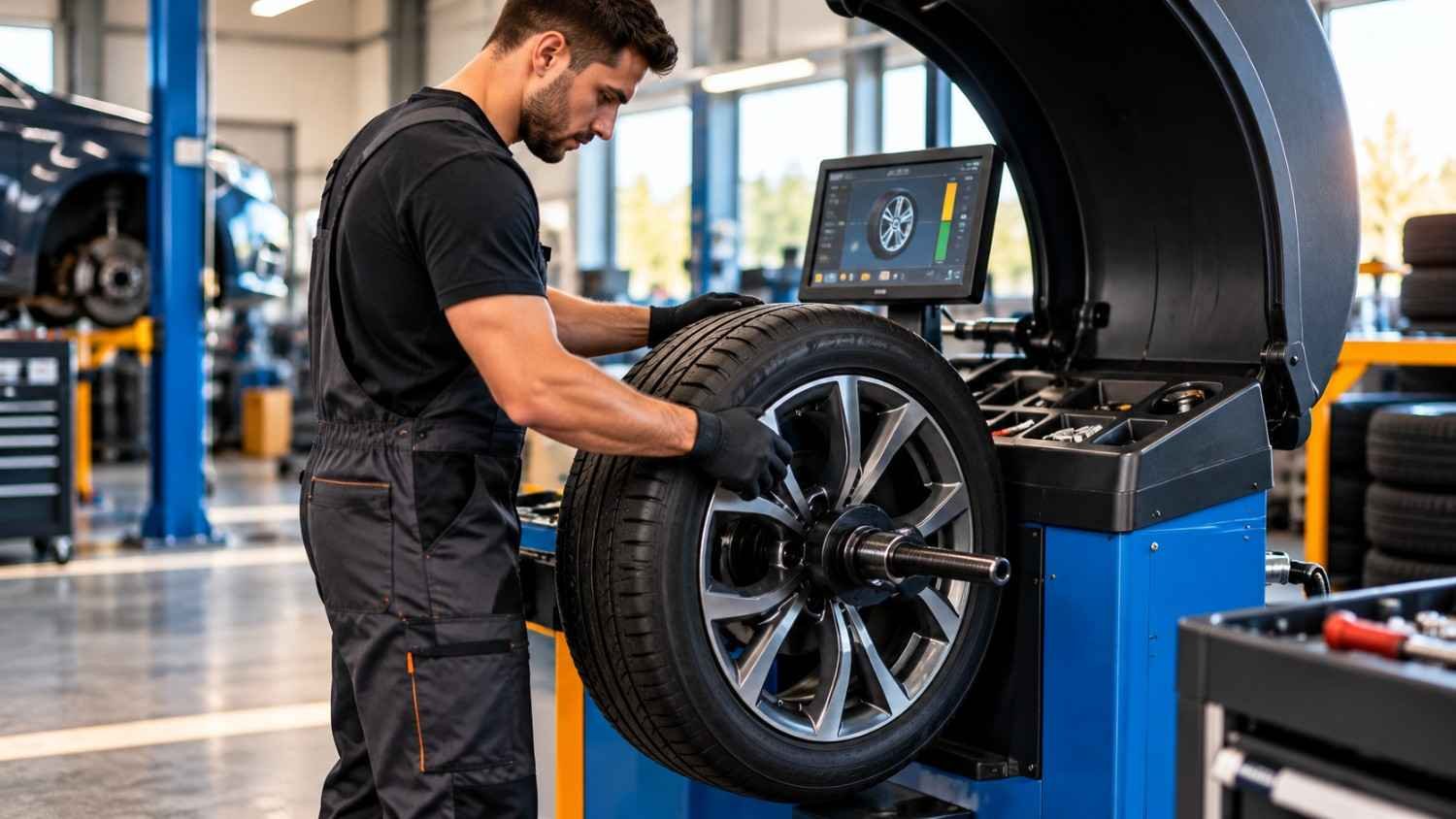
A technician mounts the wheel on a balancing machine, spins it, and measures the imbalance. Then small weights, usually clip-on or adhesive, are placed on the rim to even things out.
Balancing vs. alignment vs. rotation
These three services are often confused, and shops sometimes bundle them.
- Balancing fixes weight distribution in each wheel. It cures vibration.
- Alignment adjusts suspension angles. It cures pulling and uneven tread wear.
- Rotation moves tires between positions. It evens out wear. See our guide on AWD tire rotation and Walmart tire rotation cost.
Average Tire Balancing Cost in 2026
Here is what drivers commonly pay in the United States. Think of these as planning ranges, not guaranteed quotes.
| Service level | Typical cost per tire | Typical cost for 4 tires |
|---|---|---|
| Standard balancing (independent shop) | $10 to $25 | $40 to $100 |
| Standard balancing (national chain) | $15 to $35 | $60 to $140 |
| Dealership balancing | $20 to $50 | $80 to $200 |
| Road force balancing | $25 to $75 | $100 to $300 |
| Mount and balance (new tires) | $15 to $45 | $60 to $180 |
Estimates only. Local labor rates, wheel size, and promotions change the final price.
If you only need balancing on one tire, many shops will still charge a minimum, so ask before you go.
For a deeper look at installation pricing, read our breakdown of tire mount and balance cost.
Tire Balancing Cost by Shop
Drivers often search for a specific retailer, so here is how the big names generally handle balancing. Policies change, so treat this as a starting point and call your nearest location.
| Retailer | How balancing is usually handled | Typical range |
|---|---|---|
| Walmart | Included in its tire installation package with mounting and valve stems | About $15 to $25 per tire as part of installation |
| Costco | Included in the installation package for tires bought there, often with lifetime rebalancing | About $15 to $20 per tire for installation |
| Discount Tire | Free lifetime balancing and rotation commonly offered on tires bought there | Free with purchase; standalone pricing varies |
| Firestone Complete Auto Care | Sold per tire or in packages; often discounted with new tires | About $15 to $35 per tire |
| Mavis Tires & Brakes | Per tire or bundled with installation or rotation deals | About $15 to $35 per tire |
| Midas | Per tire; coupons are frequent | About $15 to $40 per tire |
| Pep Boys | Per tire or in a bundle with rotation | About $15 to $40 per tire |
| Independent local shop | Usually the cheapest standalone option | About $10 to $25 per tire |
Walmart tire balancing cost
Walmart typically folds balancing into its installation package rather than selling it alone. That makes it a budget-friendly option when you are buying tires there. Check the Walmart Tire Center Sunday hours before you drive over, since wait times can be long on weekends.
Costco tire balancing cost
Costco members who buy tires there generally get balancing as part of the installation package, and the retailer has long promoted lifetime rotation and rebalancing for those tires. If you are shopping for a set, keep an eye on the Costco Michelin tire sale.
Discount Tire balancing cost
Discount Tire is well known for free lifetime balancing and rotation on tires purchased from the company. If you did not buy your tires there, expect a standalone fee, and call ahead because it can vary by store. Our page on Discount Tire hours helps you plan your visit.
Firestone, Mavis, Midas, and Pep Boys
These national chains usually charge per tire and often run coupons or bundle deals. If you also need a rotation, ask for a combined price, because bundles are often cheaper than buying each service alone. Compare quotes from at least two shops.
National Tire & Battery and Big O Tires
Regional and franchise brands set pricing by location. Read our guides on National Tire & Battery and Big O Tires for background before you call.
What Affects Tire Balancing Cost?
Two drivers can walk into the same shop and pay different amounts. These are the main reasons.
1. Tire and wheel size
Larger wheels and heavy truck or SUV tires take more time and more weight. Expect to pay at the higher end for 20-inch and bigger wheels.
2. Wheel type
Alloy wheels often use adhesive weights to avoid scratching the finish, which can add a small charge compared with steel wheels using clip-on weights.
3. Type of balancing
Road force balancing uses a roller to press against the tire as it spins, which finds problems standard balancing misses. It costs more and takes longer.
4. Shop type
Dealerships generally charge the most. Independent shops tend to charge the least. Big chains sit in the middle and often discount through coupons.
5. Location
Labor rates are higher in big metro areas. A shop in a large city may charge noticeably more than one in a small town. Search our tire services by state pages to find options near you.
6. Bundles and promotions
Buying new tires, rotation, or alignment at the same time often lowers the effective price of balancing, or removes it entirely.
7. Other add-ons
Some quotes include new valve stems, TPMS service, or disposal fees. Always ask whether the price is “out the door.”
When Is Tire Balancing Free or Included?
Balancing is not always a separate expense. You may already be covered in these cases:
- You bought new tires. Mounting and balancing are almost always part of installation.
- Lifetime balancing programs. Some retailers offer free rebalancing for tires bought from them. Keep your receipt.
- Tire protection or road hazard plans. Some plans include rotation and balancing visits.
- Promotions. Seasonal sales sometimes bundle free balancing with a rotation or inspection.
Signs Your Tires Need Balancing
Do not wait for a scheduled service if you notice any of these symptoms.

- Steering wheel vibration, usually between 50 and 70 mph, points to a front tire imbalance.
- Seat or floor vibration often means a rear tire issue.
- Uneven or cupped tread wear suggests a tire has been bouncing slightly as it rolls.
- Worse fuel economy can appear when tires are not rolling smoothly.
- Noise that rises with speed can be an early warning.
A good rule: have your tires balanced whenever you install new tires, after a flat repair, if you hit a major pothole, and any time you feel a new vibration. Many technicians also recommend checking balance with every rotation, roughly every 5,000 to 7,500 miles.
Types of Tire Balancing
Static balancing
Corrects imbalance on a single plane. Fine for narrow tires and some motorcycles. Rarely used on modern cars.
Dynamic balancing
Corrects side-to-side and up-and-down imbalance. This is the standard method for passenger cars and most light trucks.
Road force balancing
Simulates the load of the road to find hidden stiffness variations. Best for stubborn vibrations and high-performance tires.
Weight-free options
Some shops use balancing beads or similar products in commercial and heavy trucks. They are uncommon for regular passenger cars.
Is road force balancing worth it?
For most drivers, standard dynamic balancing is enough. Road force balancing makes sense if you have a persistent vibration after a normal balance, run low-profile performance tires, or own a vehicle that is sensitive to ride quality. If you are shopping for performance or off-road rubber, such as the Nitto Ridge Grappler or Falken Wildpeak A/T4W, ask if the shop recommends it for those tire types.
DIY vs. Professional Tire Balancing
Static bubble balancers and home kits exist, but they are not precise enough for modern highway speeds. Professional shops use computerized spin balancers that detect differences measured in fractions of an ounce.
| Factor | DIY | Professional |
|---|---|---|
| Accuracy | Low to moderate | High |
| Equipment cost | Hundreds of dollars for a decent kit | Included in the service fee |
| Time | Slow and trial-and-error | Often 20 to 45 minutes for a full set |
| Best for | Hobbyists, off-road trailers | Daily drivers, highway cars |
For most people, paying $60 to $120 once is far cheaper than buying equipment, and it avoids premature tire wear. If you do your own inflation at home, a dependable inflator helps, and our AirMoto tire inflator review covers one option.
How to Save Money on Tire Balancing
- Buy tires and balance together. Installation bundles are the cheapest route.
- Ask about lifetime balancing. Retailers that offer it can save you money for years.
- Compare at least three quotes. Use the services directory and tire brands pages to narrow down shops.
- Hunt for coupons. Chains often post online offers for rotation plus balance.
- Combine services. Ask for rotation and balance together to get a bundled price.
- Do not skip the check-up. Catching an imbalance early prevents uneven wear that can shorten tire life.
- Call ahead. Phone quotes are free and avoid surprises. If you need service today, see our list of a tire shop open today.
Also keep tire load rating in mind when replacing tires, since the wrong load rating can lead to premature wear and vibration issues. Our guide on tire load rating explains how to read it. If you run a tire shop, you can submit your business to our directory.
What to Expect During a Balancing Appointment
Step-by-step process
- The technician removes each wheel from the vehicle.
- Old weights are cleaned off and the wheel is inspected for damage.
- The wheel is mounted on the spin balancer.
- The machine identifies where weight is needed.
- New weights are applied and the wheel is re-checked.
- Wheels are reinstalled and lug nuts are torqued to specification.
Questions to ask the shop
- Is the quote per tire or for all four?
- Are weights, valve stems, and taxes included?
- Are lug nuts torqued with a torque wrench?
- Is free rebalancing included with my tire purchase?
The Tire Industry Association offers training and standards for technicians, so asking whether a shop employs certified techs is a reasonable question. See TIA for more.
Ready to compare prices?
Browse more tire guides or find a local shop on Tire Near Me Hub.
Frequently Asked Questions About Tire Balancing Cost
How much does tire balancing cost per tire?
Most shops charge about $15 to $30 per tire for standard balancing. Independent shops can be as low as $10, while dealerships and road force balancing can reach $50 to $75.
How much does it cost to balance 4 tires?
A full set typically costs $60 to $120 at most chains and independent shops. Bundles with new tire installation can lower the effective price, and some retailers include balancing for free.
Is tire balancing free at Walmart, Costco, or Discount Tire?
It is usually included when you buy tires from these retailers. Walmart and Costco fold balancing into installation, and Discount Tire is known for free lifetime balancing and rotation on tires purchased there. Policies differ by location, so confirm before you go.
How often should tires be balanced?
Balance tires when they are installed, after a flat repair, and whenever you feel vibration. Many technicians also recommend checking balance with each rotation, about every 5,000 to 7,500 miles.
Can unbalanced tires damage my car?
Yes, over time. Imbalance can cause uneven tread wear and extra stress on suspension and steering parts. It is a small repair that prevents bigger bills.
Conclusion: Is Tire Balancing Worth the Cost?
Tire balancing is one of the cheapest services you can buy for the benefit it delivers. Expect to pay roughly $15 to $30 per tire, or $60 to $120 for a set, with higher prices for dealerships, large wheels, and road force balancing.
The smartest way to cut the cost is simple: buy tires from a retailer that includes balancing, ask about lifetime programs, bundle rotation with balancing, and compare at least three quotes. Walmart, Costco, and Discount Tire are often the best value when you buy tires there, while independent shops often win on standalone service.
If you feel vibration, do not ignore it. A quick balance protects your tires, your suspension, and your comfort on the road. Explore more guides on the Tire Near Me Hub blog to keep your tires in top shape.
Disclaimer: Prices in this article are general estimates and may vary by location, vehicle, and promotion. Confirm current pricing with your local shop.