Milwaukee Tire Inflator: M18 vs M12 Review, Specs & Buyer’s Guide (2026)
Max PSI, battery options, kits, quick-connect tips and a step-by-step how-to, all in one place.
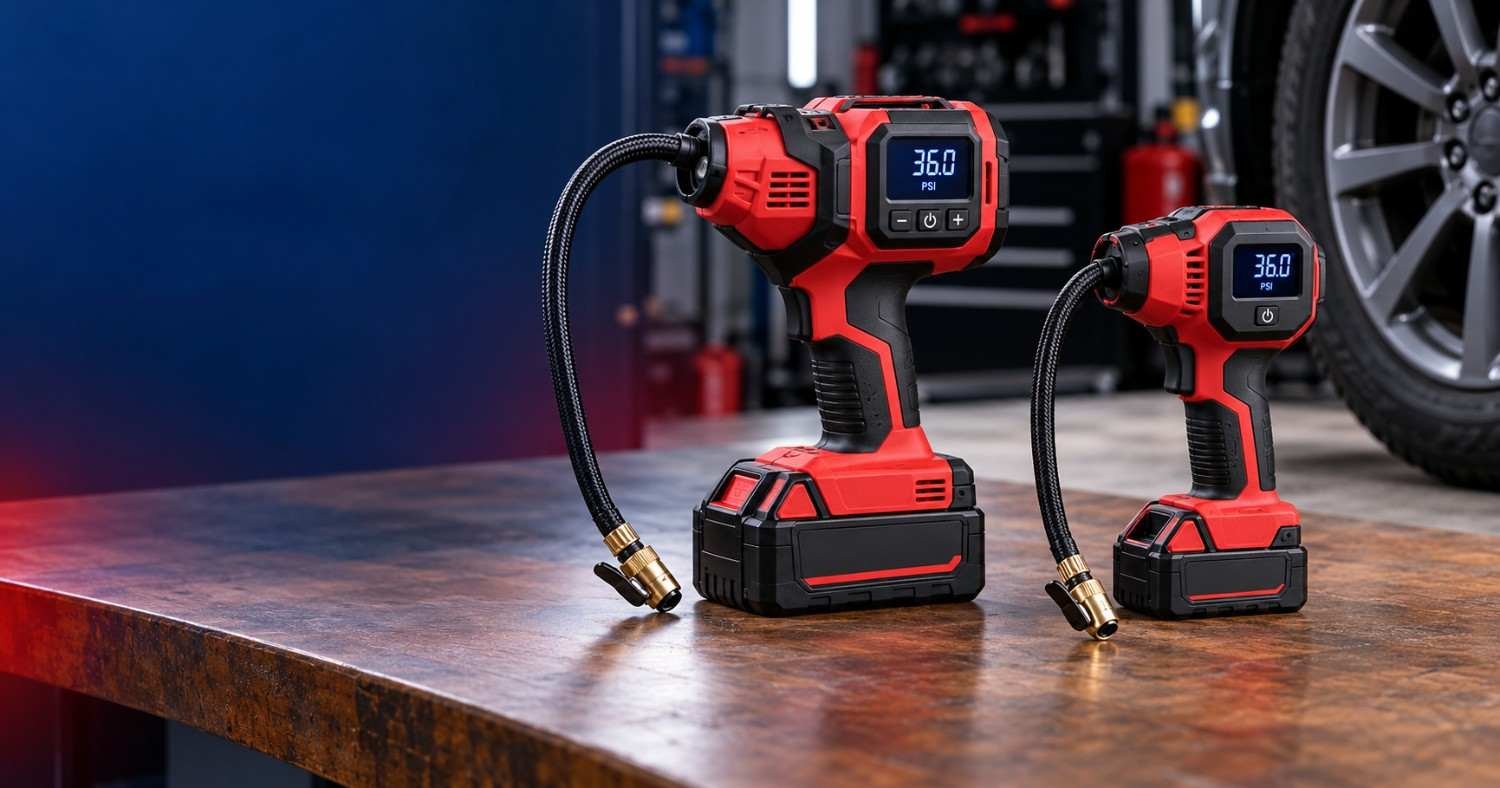
A flat tire never picks a convenient moment. Maybe it is a low-pressure light on a cold morning, a truck tire that needs topping off at the job site, or a trailer sitting at a campsite with no gas station nearby. That is exactly where a Milwaukee tire inflator earns its place in the toolbox.
Milwaukee sells two cordless inflators: the compact M12 Compact Inflator (2475-20) and the bigger M18 Inflator (2848-20). Both run on batteries, both shut off automatically at a target pressure, and both skip the noise and cords of a shop compressor. They are not identical, though, and picking the wrong one can mean slower fills, an extra battery purchase, or paying for power you never use.
This guide compares the two side by side, explains what comes in a kit versus a bare tool, shows how to use one correctly, and answers the questions drivers ask most. Specs below come from Milwaukee’s published product data and major retailers, checked in October 2026.
What a Milwaukee Tire Inflator Is (and Is Not)
A Milwaukee cordless inflator is a battery-powered pump with a digital gauge and a short hose. You set a target PSI, screw the chuck onto the valve stem, and the tool fills the tire and stops itself.
It is not a tank-style air compressor. There is no storage tank and it cannot run air tools like an impact wrench or nail gun. Think of it as a very capable tire and ball inflator, built for car, SUV, light truck, trailer and bicycle tires.
Why drivers keep one in the trunk
- Safety: NHTSA’s tire safety guidance stresses that correct inflation matters for handling, braking and tire life. Its 2001 tire pressure study found that roughly one in four passenger cars had at least one tire substantially underinflated.
- Fuel economy: the U.S. Department of Energy says keeping tires properly inflated can improve gas mileage by up to 3%.
- Convenience: no waiting in line at a gas station air machine, and no coins needed.
- Accuracy: automatic shut-off hits the number you set, instead of guessing with a dial.
If a warning light is what sent you here, read our guide on a low tire pressure light that will not turn off after you inflate.
Milwaukee M18 Inflator (2848-20): Specs and Real-World Fit
The M18 is Milwaukee’s high-capacity cordless inflator. It is sold as a bare tool and runs on any M18 battery. Milwaukee says it tops off a 33-inch light truck tire in under one minute.
| Spec | Milwaukee M18 Inflator 2848-20 |
|---|---|
| Max pressure | 150 PSI |
| Battery | Any M18 battery (not included with tool-only) |
| Hose | 36 in. with all-brass Schrader chuck |
| Auto shut-off | TrueFill technology with auto pressure check |
| PSI memory | 4 saved presets |
| Included accessories | Schrader chuck, Presta chuck, inflation needle, inflator nozzle |
| Size | About 13.8 x 6.4 x 7.8 in. |
| Warranty | 5-year tool warranty |
What stands out
- TrueFill pressure check: the tool waits for the reading to stabilize, checks system pressure, then fills until the target is reached.
- Four PSI memory slots: save your car, truck, trailer and bike numbers once and recall them in a tap.
- On-board storage: the hose and attachments store on the tool itself, so nothing rattles loose in a truck bed.
- Anti-vibration feet: the unit stays put on pavement while it runs.
Who should buy the M18
The M18 fits owners of pickups, SUVs, work vans and trailers, and anyone who already has M18 batteries. If the vehicles you service wear larger tires, the extra headroom is worth it. Our guide to a portable tire inflator for trucks explains why volume matters on bigger tires.
Milwaukee M12 Compact Inflator (2475-20): Small, Light, Capable
The M12 was Milwaukee’s first cordless tire inflator. It is smaller and cheaper than the M18 and rated for up to 120 PSI, which covers nearly every passenger vehicle tire.
| Spec | Milwaukee M12 Compact Inflator 2475-20 |
|---|---|
| Max pressure | 120 PSI |
| Battery | Any M12 battery |
| Hose | 26 in. with all-brass Schrader chuck |
| Gauge | Backlit digital LCD, about +/- 3% accuracy |
| Speed (Milwaukee claim) | Car tire from 28 to 35 PSI in under 1 minute; LT truck tire from 30 to 45 PSI in under 4 minutes |
| Included accessories | Schrader chuck, Presta chuck, ball needle, nozzle |
| Warranty | 3 years |
Strengths and trade-offs
The M12 is easy to keep in a car trunk, a toolbox or a work van. Reviewers on sites like ToolGuyd and Pro Tool Reviews praised its size and the way it fills to a set pressure and stops. On the other hand, owners on forums report it can run warm and works harder on large truck tires. That is normal for a compact pump, and it is the main reason heavy users step up to the M18.
Milwaukee M12 vs M18 Tire Inflator: Side-by-Side Comparison
Searching for milwaukee tire inflator m12 vs m18? This table puts the key differences in one place.
| Feature | M12 (2475-20) | M18 (2848-20) |
|---|---|---|
| Max PSI | 120 | 150 |
| Voltage | 12V | 18V |
| Hose length | 26 in. | 36 in. |
| PSI presets | Manual setting | 4 memory slots |
| Best for | Cars, bikes, occasional truck tires | Trucks, SUVs, trailers, frequent use |
| Warranty | 3 years | 5 years |
| Price tier | Lower | Higher |
Choose the M18 if…
- You already own M18 batteries
- You fill truck, SUV or trailer tires often
- You want saved PSI presets and a longer hose
- You want the longer 5-year warranty
Choose the M12 if…
- You own M12 tools or want a kit with a battery
- You mostly fill car, bike and ball pressures
- Trunk space and weight matter
- You want the lower price
One more factor: tire pressure for heavier vehicles depends on load as well as size. If you tow or haul, our explainer on tire load rating helps you set pressures correctly.
Milwaukee Tire Inflator Kit, Tool Only, or With Battery and Charger?
This is where many shoppers get tripped up. Milwaukee sells these tools several ways:
- Tool only (bare tool): the inflator without a battery or charger. The M12 version is 2475-20 and the M18 version is 2848-20. Best value if you own the platform.
- Kit: the M12 is also sold as kits such as 2475-21XC and 2475-21CP, which pair the tool with a battery and charger.
- Bundles: retailers such as Home Depot sometimes pair a Milwaukee inflator with batteries and a charger at promotional prices. Check what is actually in the box before you check out.
Rough pricing in October 2026
Several U.S. retailers listed the M12 tool-only inflator at roughly $120 to $145. M18 pricing varies more by seller and promotion, so compare listings and look for battery bundles. Treat all prices as a snapshot, since they change often.
How to Use a Milwaukee Tire Inflator Step by Step
Using one is simple, but a few habits make fills more accurate. The steps below work for both the M12 and the M18.
Step 1: Find the right PSI for your vehicle
Use the pressure on the tire placard, usually a sticker on the driver’s door jamb, or in the owner’s manual. Do not use the “max PSI” molded into the sidewall. That number is the tire’s limit, not the recommended pressure. A good tire pressure gauge lets you verify the inflator’s reading.
Step 2: Check the tires when they are cold
Measure before driving, or after the car has sat for a few hours. Warm tires read higher and lead you to underfill.
Step 3: Inflate
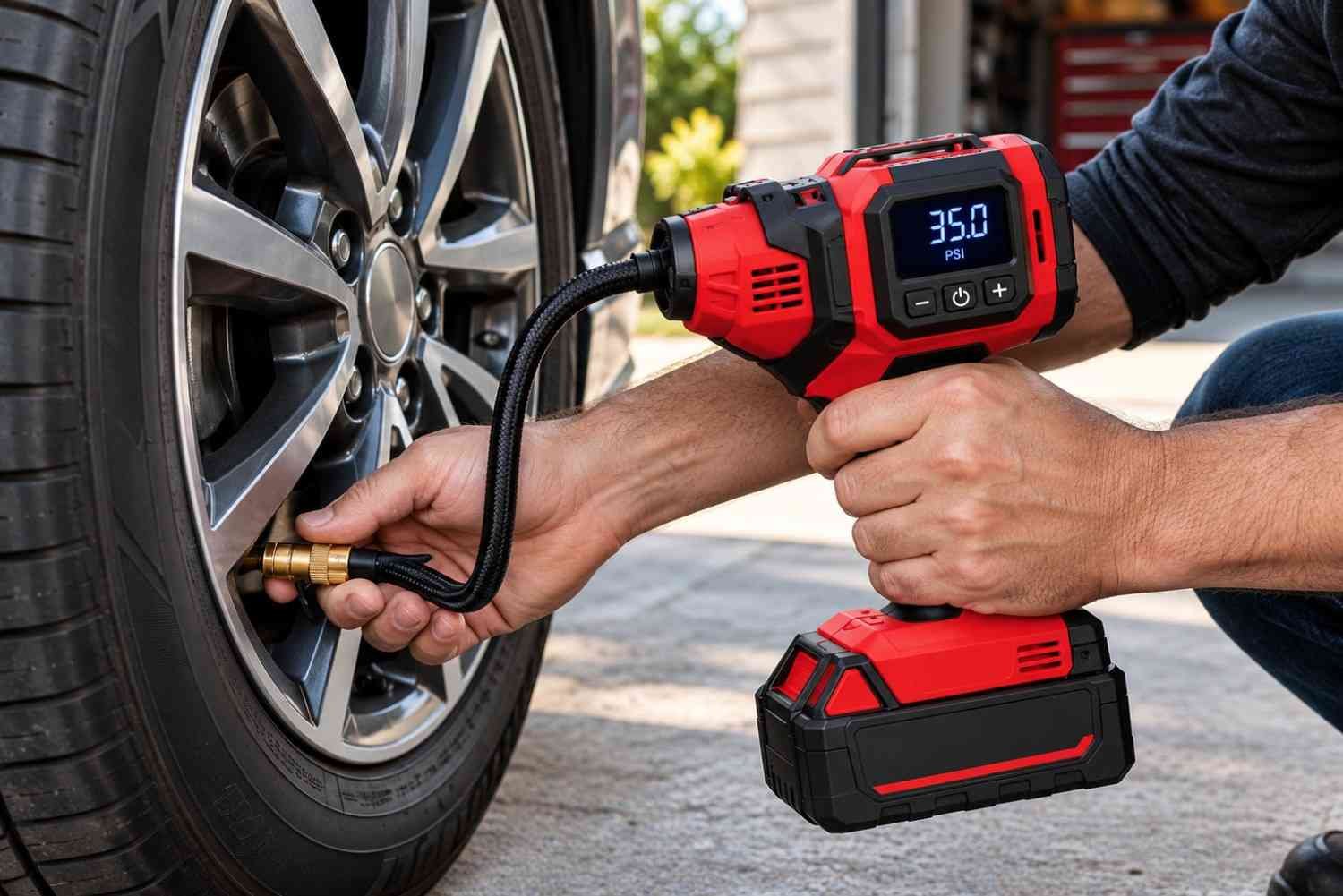
- Attach a charged battery to the inflator.
- Set your target PSI on the display before connecting the hose.
- Remove the valve cap and wipe the stem clean.
- Screw the chuck on firmly until the hissing stops.
- Start the inflator and let it run until it stops itself at the set pressure.
- Remove the chuck quickly, replace the valve cap and repeat on each tire.
Don’t forget the spare
Many spare tires need a higher pressure than the road tires, and they are the ones people forget until they are needed. Check the spare at least twice a year.
- If a tire keeps losing air, do not keep refilling it. It may have a nail or a bad valve. See our tire shop open today guide to find a shop fast.
- After a fill, look at the tread and sidewalls for bulges, cracks or damage.
- All-wheel-drive vehicles need all four tires matched. Our AWD tire rotation article explains why.
Milwaukee Tire Inflator Quick Connect: Can You Upgrade the Chuck?
Out of the box, the M18 uses a hose with a screw-on brass Schrader chuck. Some owners prefer a faster, lever-style or quick-connect fitting, so searches like quick connect for Milwaukee tire inflator are common.
Aftermarket quick-connect and lock-on chucks exist, but Milwaukee does not list one as an official accessory in the product data reviewed for this article. If you add one, confirm that the thread size matches your hose, that it is rated above your highest working pressure, and that it does not leak at the connection. A leaking fitting can make TrueFill shut-off readings less accurate.
Where to Buy a Milwaukee Tire Inflator and How to Find Deals
Milwaukee inflators are sold at big-box home improvement stores, tool retailers and online marketplaces. Searches such as Home Depot Milwaukee tire inflator are popular because the store often runs tool-and-battery promotions.
- Compare tool-only vs kit pricing: a kit with a battery can cost less than buying the parts separately, especially during sales.
- Watch seasonal sales: Black Friday and Father’s Day events regularly include Milwaukee bundles.
- Check seller and warranty: buy from authorized sellers so the 3-year (M12) or 5-year (M18) warranty applies.
- Confirm the model number: 2475-20 is the M12 inflator and 2848-20 is the M18.
You can verify product details on Milwaukee’s official M12 Compact Inflator page.
Milwaukee vs Cheaper Cordless Inflators
Milwaukee is not the only option. Ryobi sells an 18V digital inflator for a fraction of the price, which was listed around $40 in one 2025 roundup. If you only top off tires occasionally, a budget model may be enough. Our Ryobi tire inflator review covers how it stacks up, and our AirMoto tire inflator article looks at a popular stand-alone alternative.
| Priority | Best pick |
|---|---|
| Lowest cost for occasional use | Budget inflator (for example Ryobi) |
| Compact car or bike inflator on M12 | Milwaukee M12 2475-20 |
| Trucks, SUVs, frequent fills on M18 | Milwaukee M18 2848-20 |
| No battery system at all | 12V plug-in or stand-alone rechargeable inflator |
Remember that a cheaper inflator does not replace a good gauge or a trip to a tire shop when damage is suspected. Browse tire brands and tire services on our site when it is time to repair or replace.
Maintenance and Safety Tips for Your Milwaukee Inflator
- Let it cool: compact inflators are built for intermittent use, so pause between multiple large tires.
- Do not exceed the tire’s limit: the tool’s PSI rating is not the tire’s rating.
- Store the hose properly: use the on-board storage and keep the chuck clean.
- Keep batteries charged: a half-empty battery can stop a fill on a bigger tire.
- Do not use it as a compressor: it is for tires, balls and small inflatables, not air tools.
Looking for professional help instead? Use our state-by-state tire shop directory, or check store hours with our Discount Tire hours guide. If you run a shop, you can add it through the business submission page.
Milwaukee Tire Inflator FAQ
What is the max PSI of a Milwaukee tire inflator?
The M18 inflator (2848-20) is rated to 150 PSI. The M12 Compact Inflator (2475-20) is rated to 120 PSI. Both cover typical car, SUV and light truck pressures.
Is the Milwaukee M18 or M12 tire inflator better?
The M18 is faster on large tires, has a longer hose and 4 saved presets. The M12 is smaller and costs less. Pick the one that matches the battery platform you already own, since that decides your total cost.
Does a Milwaukee tire inflator come with a battery?
Tool-only models such as 2475-20 and 2848-20 do not include a battery or charger. Some M12 kits, such as 2475-21XC, do. Always read the listing to see what is in the box.
Can a Milwaukee inflator fill a truck tire?
Yes. Milwaukee says the M18 can top off a 33-inch light truck tire in under a minute, and the M12 can bring an LT tire from 30 to 45 PSI in under 4 minutes. A completely flat large tire will take longer.
Is a Milwaukee tire inflator worth it?
It is worth it if you want accurate, cordless inflation and you use Milwaukee batteries already. If you only need air once or twice a year, a cheaper inflator or a gauge plus a gas station pump may be enough.
Conclusion: Which Milwaukee Tire Inflator Should You Buy?
A Milwaukee tire inflator is a practical upgrade for anyone tired of guessing tire pressure. The M18 (2848-20) delivers up to 150 PSI, a 36-inch hose, saved presets and a 5-year warranty, which suits trucks, SUVs and heavy users. The M12 (2475-20) offers 120 PSI in a smaller, lower-cost package that handles cars, bikes and the occasional truck tire.
Before buying, match the battery platform, decide between tool-only and a kit, and confirm the model number. Then set the PSI from the door-jamb placard, fill when the tires are cold, and verify with a separate gauge.
Keep exploring our tire blog for more guides, or head to the Tire Near Me Hub homepage to find a trusted shop when a tire needs more than air.
Last Updated: