Tire Load Rating Explained: Load Index, Load Range Letters & Chart
Learn how to read the numbers and letters on your sidewall, compare SL vs XL tires, and choose the right load rating for your car, truck, trailer or motorcycle.
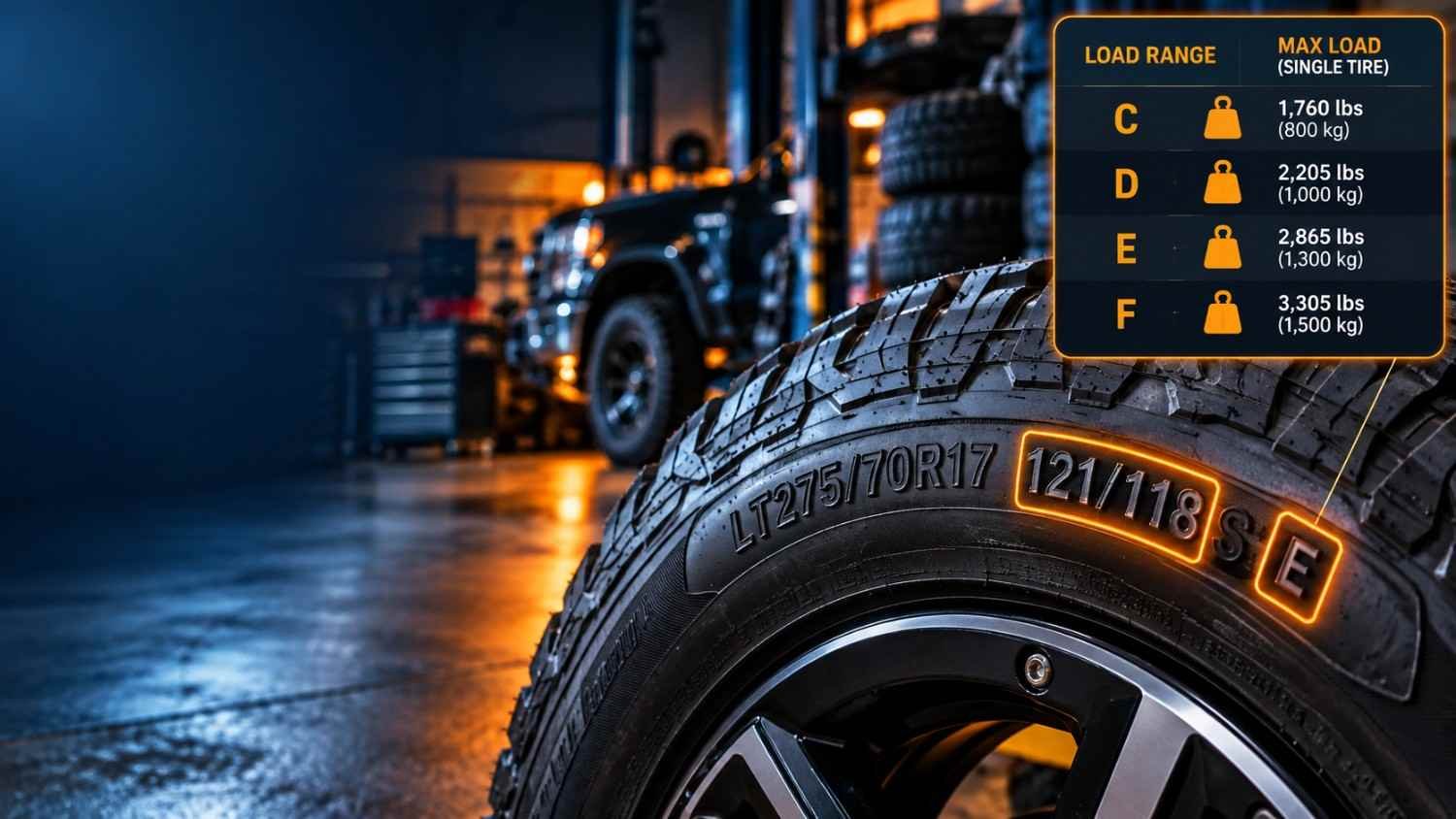
Every tire sidewall is covered in codes, and most drivers only glance at the size. That is a missed opportunity. The tire load rating is one of the most important safety details on the tire, because it decides how much weight your vehicle can legally and safely carry.
Fit a tire with too low a rating and it can overheat, wear out early or fail under stress. This guide breaks the topic down in plain English, with a tire load rating chart, real examples and practical tips. If a shop visit is on the cards, the team at Tire Near Me Hub also helps readers find trusted local tire shops.
What Is a Tire Load Rating?
A tire is an air-filled structure. The air inside, not the rubber, carries most of the vehicle’s weight. A tire’s load rating tells you how much weight that structure can support when it is inflated correctly.
Two systems are used, depending on the tire type:
- Load index: a number (such as 91 or 104) that maps to a weight in pounds or kilograms.
- Load range: a letter (B through H) used mostly on light truck (LT) and special trailer (ST) tires. It describes the tire’s construction strength and its maximum inflation pressure.
The rating applies per tire. A car with four tires rated 1,356 lbs each has a combined tire capacity of 5,424 lbs. That number must be higher than the heaviest your vehicle will ever weigh when loaded.
Where to Find the Load Rating on Your Tire
The load rating is molded into the sidewall as part of the size code. Take this common example:
P225/60R17 98H
- P – passenger vehicle tire
- 225 – width in millimeters
- 60 – aspect ratio (sidewall height as a percentage of width)
- R – radial construction
- 17 – wheel diameter in inches
- 98 – the load index (1,653 lbs per tire)
- H – the speed rating (up to 130 mph)
The sidewall also carries a line such as “MAX LOAD 1653 LBS (750 KG) AT 35 PSI”. That line confirms the maximum load and the pressure needed to reach it.
Check Your Vehicle’s Tire Placard Too
Open the driver’s door and look at the tire and loading information label on the door jamb. It lists the original tire size, the recommended cold inflation pressure and the vehicle’s maximum load. Replacement tires should meet or exceed the load index of the original tires.
Owner’s manuals repeat this information. For a broader look at how sizes and codes work together, see our guide to the tire speed rating chart.
Tire Load Index Chart (Load Rating Table)
This tire load rating chart covers the most common load index numbers. Always confirm the exact figure on your own tire or with the manufacturer, since tables can differ slightly in rounding.
| Load Index | Pounds (lbs) | Kilograms (kg) | Typical Use |
|---|---|---|---|
| 75 | 853 | 387 | Small compact cars |
| 80 | 992 | 450 | Small compact cars |
| 85 | 1,135 | 515 | Compact cars |
| 88 | 1,235 | 560 | Compact and mid-size cars |
| 91 | 1,356 | 615 | Mid-size sedans |
| 95 | 1,521 | 690 | Sedans and crossovers |
| 98 | 1,653 | 750 | Crossovers and small SUVs |
| 100 | 1,764 | 800 | SUVs and minivans |
| 104 | 1,984 | 900 | Large SUVs |
| 108 | 2,205 | 1,000 | Large SUVs, light trucks |
| 112 | 2,469 | 1,120 | Half-ton and heavy-duty pickups |
| 116 | 2,756 | 1,250 | Heavy-duty pickups |
| 120 | 3,086 | 1,400 | Heavy-duty trucks and vans |
| 126 | 3,748 | 1,700 | Commercial and heavy-duty trucks |
Example: Is a 91 Load Index Enough?
A mid-size sedan has a gross vehicle weight rating (GVWR) of about 4,400 lbs. Four tires with a load index of 91 can carry 4 × 1,356 = 5,424 lbs. That leaves a comfortable safety margin. The same tires on a heavier crossover with a 6,000 lb GVWR would fall short.
Load Range Letters: Tire Load Rating C, D, E and F
Load range letters go back to the old “ply rating” system, when tires were built from layers of cotton cord. Modern radial tires use steel and polyester, but the letters stayed as a shorthand for strength. A tire marked Load Range E is not literally ten plies; it is built to the strength standard of a 10-ply tire.
| Load Range | Ply Rating | Max Pressure (typical LT/ST) | Common Use |
|---|---|---|---|
| B | 4-ply | 35 psi | Light trailers, small utility tires |
| C | 6-ply | 50 psi | Light trucks, small trailers, vans |
| D | 8-ply | 65 psi | Light trucks, mid-weight trailers |
| E | 10-ply | 80 psi | 3/4-ton and 1-ton trucks, RVs, towing |
| F | 12-ply | 95 psi | Heavy-duty trucks, large trailers |
| G | 14-ply | 110 psi | Commercial work trucks |
| H | 16-ply | 125 psi | Severe commercial duty |
Tire Load Rating C
Load Range C suits light-duty needs: small utility trailers, light pickups and cargo vans that rarely run near their limits. It rides more softly than the heavier ranges.
Tire Load Rating D
Load Range D adds extra capacity for mid-weight trailers and trucks that haul loads regularly but not at the maximum.
Tire Load Rating E
Load Range E is the most common choice for pickup owners who tow campers, boats or equipment. The tire handles higher pressure and heavier loads, but the ride can feel firmer when the truck is empty. Drivers browsing rugged options can read the Nitto Ridge Grappler tire guide to see how load ranges appear in real tire lines.
Tire Load Rating F
Load Range F is built for heavy-duty trucks, large fifth-wheel trailers and work vehicles. It is stiffer, more puncture resistant and needs higher inflation pressures to perform properly.
SL vs XL Tire Load Rating
Passenger tires come in two main load types: Standard Load (SL) and Extra Load (XL, also marked “Reinforced” or RF). The size can be identical, yet the capacity is not.
| Feature | SL (Standard Load) | XL (Extra Load) |
|---|---|---|
| Construction | Standard casing | Reinforced casing |
| Reference inflation for rated load | About 35–36 psi | About 41–42 psi |
| Load capacity | Standard | Higher for the same size |
| Ride comfort | Usually softer | Can feel slightly firmer |
| Typical vehicles | Sedans, hatchbacks | SUVs, crossovers, performance and electric cars |
The rule is simple: never swap an XL tire for an SL tire if the vehicle was built for XL. The lower load capacity can put the tire under constant stress. Going the other way, from SL to XL, is acceptable as long as pressures follow the vehicle placard.
Electric vehicles deserve special attention. Their heavy battery packs often require XL tires, so the label on the door jamb is worth a second look before buying.
Truck, Trailer and Motorcycle Tire Load Rating
Truck Tires
Light truck (LT) tires use both a load index and a load range letter. Many carry a dual rating such as 120/116, which means 3,086 lbs on a single wheel and 2,756 lbs when used in a dual rear-wheel pair.
Trailer Tires
Special trailer (ST) tires are designed to carry weight, not steer or accelerate. They use load range letters (C, D, E) and need to match the trailer’s axle rating.
Motorcycle Tires
Motorcycle tires also carry a load index, usually in the 50s and 60s, shown next to the speed symbol, for example 120/70ZR17 58W.
Truck Tire Load Rating Chart
| Truck Class | Common Load Range | Typical Load Index Zone |
|---|---|---|
| Compact pickup | SL, XL or C | 100–110 |
| Half-ton pickup (1500) | SL, XL or E | 108–121 |
| 3/4-ton pickup (2500) | E | 120–129 |
| 1-ton pickup (3500) | E or F | 121–131 |
Shoppers comparing all-terrain options for these trucks can also read our roundup of the best all-terrain tires.
Trailer Tire Load Rating Chart
For trailers, check the axle weight rating (GAWR) on the trailer’s compliance label. Each axle’s tires must carry at least that weight combined.
| Trailer Type | Typical Load Range | Notes |
|---|---|---|
| Small utility trailer | B or C | Light loads, short trips |
| Boat trailer | C or D | Look for corrosion resistance |
| Travel trailer or camper | D or E | Leave a safety margin |
| Horse, car-hauler or fifth-wheel | E or F | Heavy tongue weight, high loads |
Motorcycle Tire Load Rating Chart
| Load Index | Pounds (lbs) | Kilograms (kg) |
|---|---|---|
| 54 | 467 | 212 |
| 58 | 521 | 236 |
| 62 | 584 | 265 |
| 66 | 661 | 300 |
| 69 | 716 | 325 |
| 73 | 805 | 365 |
Remember that a motorcycle carries its load on just two tires, so the rider, passenger, luggage and fuel all count. Match front and rear ratings to the owner’s manual, and keep pressures accurate with a reliable tool such as the Airmoto tire inflator.
Load Index vs Load Range vs Speed Rating
These three ratings are often confused. Each answers a different question.
| Rating | Format | What It Tells You | Where It Is Used |
|---|---|---|---|
| Load Index | Number (e.g. 98) | Maximum weight per tire | All tires |
| Load Range | Letter (e.g. E) | Strength and max pressure | LT and ST tires |
| Speed Rating | Letter (e.g. H) | Maximum sustained speed | All tires |
| SL / XL | Marking | Standard or extra load capacity | Passenger tires |
In short, the load index says how much, the load range says how tough, and the speed rating says how fast.
How to Choose the Right Tire Load Rating
Choosing the right rating is a matter of matching the tire to the job. Follow this process:
- Start with the placard. Note the original size, load index and pressure on the door jamb label.
- Know your real weight. Add passengers, cargo, accessories, roof racks and any tongue weight from a trailer.
- Check axle limits. Compare the weight on each axle with the gross axle weight rating (GAWR).
- Pick the rating. Choose a load index equal to or higher than original equipment.
- Add a margin. Aim for around 10–15% extra capacity if the vehicle regularly tows or hauls.
- Set the pressure. Use the placard pressure, adjusting only as the manufacturer allows.
Practical Tips From the Shop Floor
- Check pressure monthly and before any long trip, with tires cold.
- Replace tires in sets of four, or at least in pairs on the same axle.
- Never mix different load ranges on the same axle.
- Inspect sidewalls for bulges, cracks and heat damage when hauling heavy loads.
- Tires have an age limit too. Our guide on how long tires last explains when to replace them, even with plenty of tread left.
Where to Buy the Right Tires
Once the rating is clear, comparing retailers is the next step. Readers can explore trusted names such as Big O Tires and National Tire & Battery, browse all tire brands, or open the states directory to find shops nearby. Planning a same-day visit? Check Discount Tire hours, see which tire shops are open today or find out whether the Walmart Tire Center is open on Sundays. The services page lists installation, balancing and repair options.
Common Tire Load Rating Mistakes to Avoid
- Buying by size only. Two tires of the same size can have very different load indexes.
- Ignoring the weight of gear. Tool boxes, bed covers, camper shells and water tanks add up fast.
- Overinflating to “fix” a low rating. Extra air does not safely raise capacity beyond the tire’s limit.
- Mixing SL and XL. Different capacities on one vehicle cause uneven handling.
- Forgetting trailer tongue weight. It is added to the tow vehicle’s rear axle load.
- Assuming a higher letter is always better. Match the tire to the job, not the other way around.
Tire Load Rating FAQs
What does tire load rating mean?
It is the maximum weight one tire can safely support at its specified air pressure. It appears as a number (load index) on all tires and as a letter (load range) on light truck and trailer tires.
What is the difference between load range E and load range F?
Load Range E is a 10-ply rated tire with a typical maximum pressure of 80 psi. Load Range F is a 12-ply rated tire with a typical maximum of 95 psi, so it carries more weight but rides stiffer.
Is XL tire load rating better than SL?
XL tires have a reinforced construction and carry more weight at higher pressure than SL tires of the same size. They are better for heavy vehicles, but a standard-load tire is fine when the vehicle was designed for it.
Can I use a tire with a higher load rating than my original tires?
Yes, in most cases. A higher load index is safe, but the ride may be firmer. Never go lower than the vehicle manufacturer’s original specification.
Where do I find my tire load rating?
Look at the sidewall size code, such as 98H, where 98 is the load index. The door jamb placard and owner’s manual also list the recommended specification.
Conclusion: Make Tire Load Rating Part of Every Tire Decision
The tire load rating is more than a number on the sidewall. It is the link between your vehicle’s weight and the tire’s strength. The load index tells you how many pounds each tire supports, the load range letters (C, D, E and F) show the tire’s toughness and pressure limit, and SL or XL markings show how much reinforcement the tire has.
Before buying, check the door jamb placard, add up your real-world loads and choose a rating equal to or above the original. Keep pressures correct and allow a safety margin for towing and hauling.
Ready to take the next step? Explore the Tire Near Me Hub blog for more guides, or if you run a tire shop, join the directory through the business submission page.