Tire Speed Rating Chart: The Complete Guide to Every Letter, MPH & KM/H
Understand exactly what your tire’s speed rating letter means, how it’s tested, and which rating fits your car, truck, trailer, or motorcycle — with the full official chart included.
Last Updated: September 19, 2026Quick Navigation
- What Is a Tire Speed Rating?
- Full Tire Speed Rating Chart (MPH & KM/H)
- How to Read the Rating on Your Sidewall
- Car Tire Speed Rating Chart
- Truck & Commercial Truck Speed Ratings
- Trailer (ST) Tire Speed Rating Chart
- Motorcycle Tire Speed Rating Chart
- Michelin & Goodyear Speed Rating Notes
- Why the Speed Rating Actually Matters
- How to Choose the Right Rating
- FAQs
Every tire sold in the United States carries a small letter stamped near the end of its sidewall code — and most drivers never notice it. That single character is the tire speed rating, and it tells you the fastest speed the tire can sustain, under proper load and inflation, without breaking down from heat. Ignore it, and you risk everything from a rougher ride to a dangerous blowout on the highway.
This guide breaks down the complete tire speed rating chart, shows how to read it on your own sidewall, and gives you rating charts specific to cars, trucks, trailers, and motorcycles — so you can buy the correct replacement tire the first time.
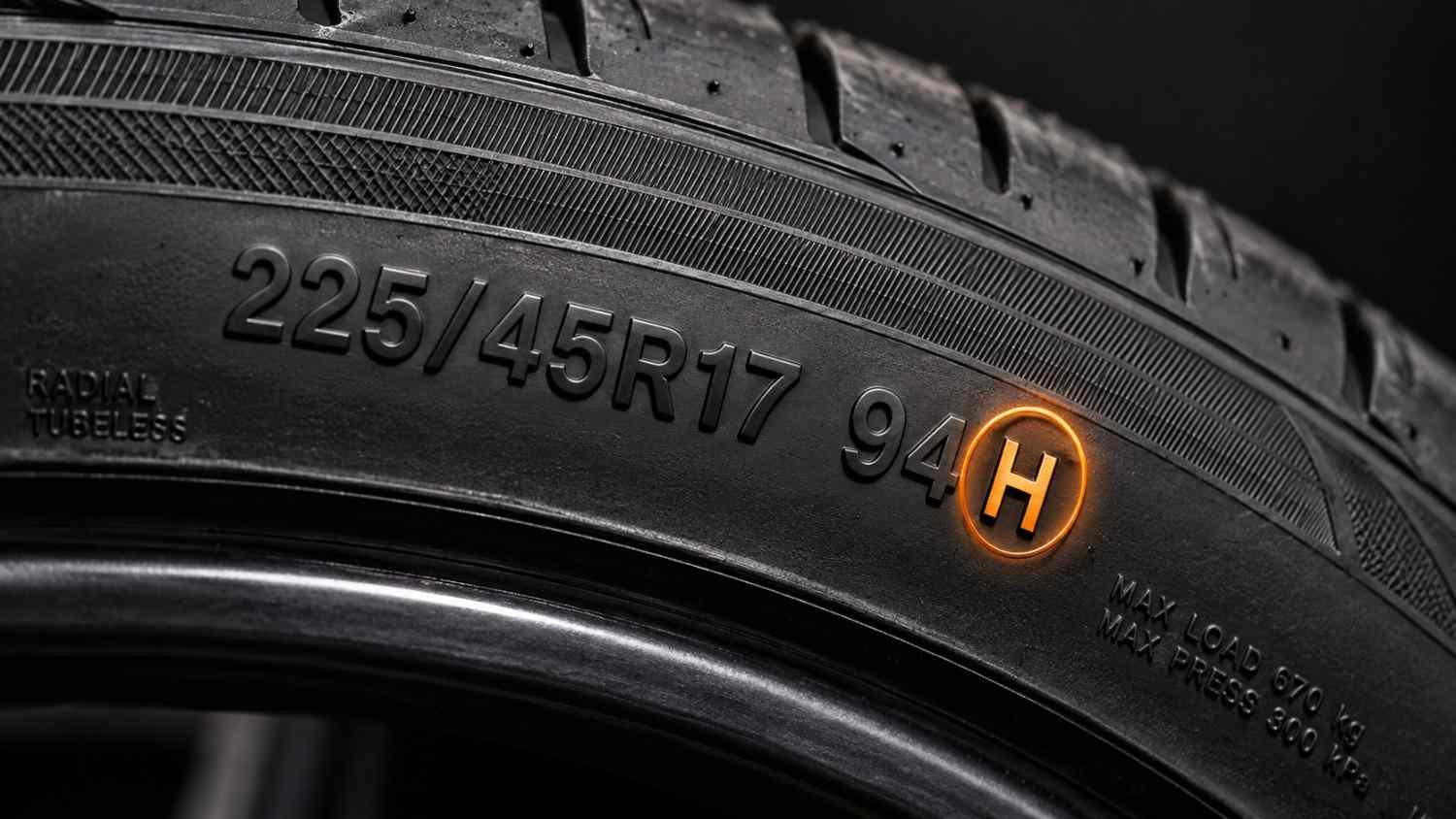
The speed rating letter appears right after the load index in the tire’s sidewall code.
What Is a Tire Speed Rating?
A tire speed rating is a letter grade, from A to Y, that indicates the maximum speed a tire can safely maintain over time when it’s properly inflated and not overloaded. It’s part of the tire’s “service description” — the combination of numbers and letters printed right after the tire size, such as 225/45R17 94H. In that example, “94” is the load index and “H” is the speed symbol.
The rating comes from a standardized lab test: engineers mount the tire on a machine and spin it against a large steel drum, increasing the speed in set intervals every few minutes until the tire reaches its target speed and holds it for a fixed duration without failing. Manufacturers follow testing protocols set by organizations like the National Highway Traffic Safety Administration (NHTSA) and international standards bodies, so the letters mean the same thing regardless of brand.
Full Tire Speed Rating Chart (MPH & KM/H)
Below is the complete, industry-standard tire speed rating chart covering every symbol from the lowest agricultural ratings to the highest performance ratings.
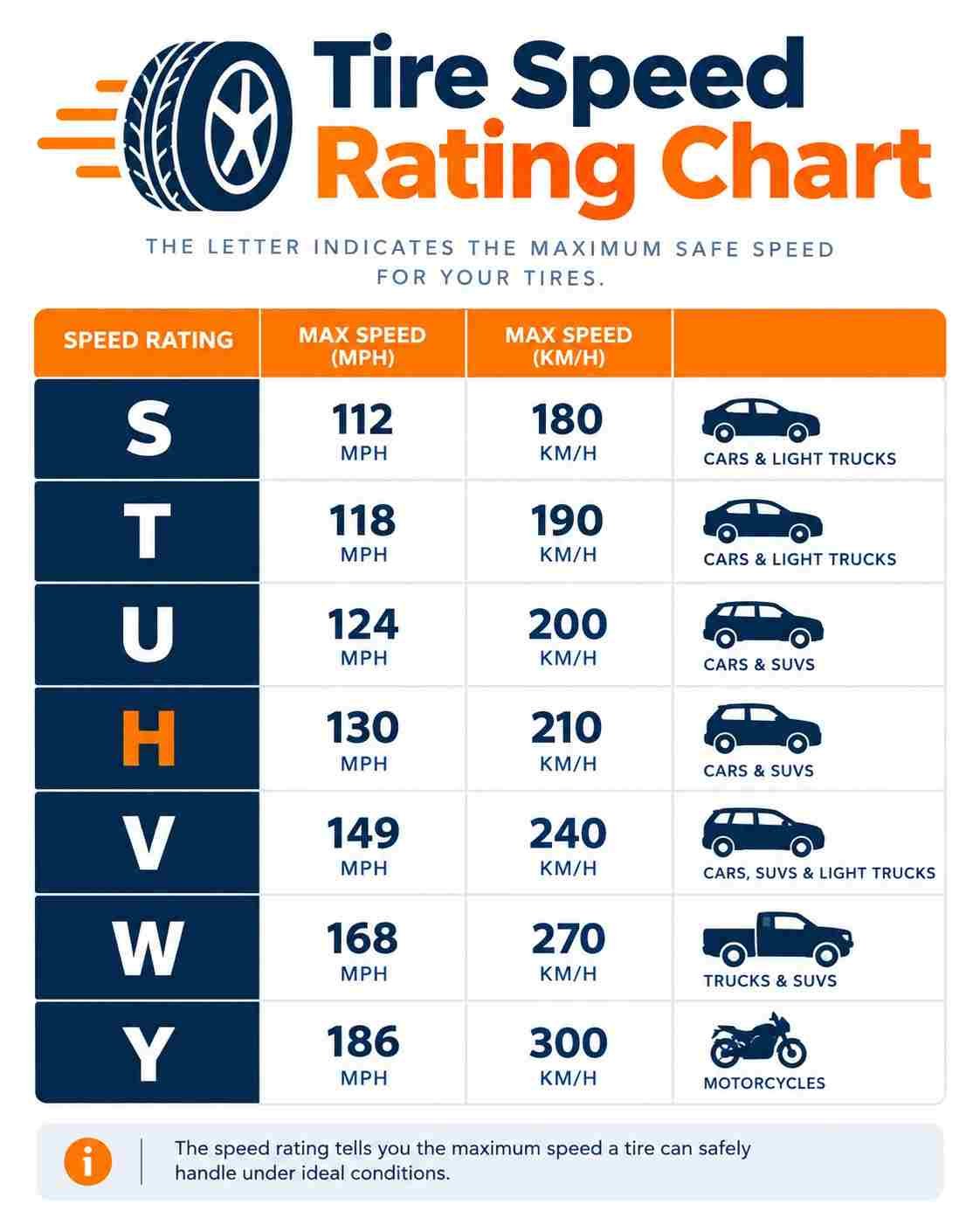
Common passenger tire speed ratings from S to Y, with mph and km/h equivalents.
| Speed Symbol | Max Speed (MPH) | Max Speed (KM/H) | Typical Use |
|---|---|---|---|
| A8 | 25 | 40 | Agricultural / off-road |
| B | 31 | 50 | Agricultural / towed equipment |
| C | 37 | 60 | Light commercial / temporary |
| D | 40 | 65 | Temporary spare tires |
| E | 43 | 70 | Temporary spare tires |
| F | 50 | 80 | Light truck / trailer |
| G | 56 | 90 | Light truck / trailer |
| J | 62 | 100 | Light truck / commercial |
| K | 68 | 110 | Light truck / trailer (ST tires) |
| L | 75 | 120 | Off-road & light-truck tires |
| M | 81 | 130 | Temporary spare tires |
| N | 87 | 140 | Temporary spare tires |
| P | 93 | 150 | Light-truck / off-road |
| Q | 99 | 160 | Studless winter tires, SUVs |
| R | 106 | 170 | Heavy-duty light-truck tires |
| S | 112 | 180 | Family sedans & vans |
| T | 118 | 190 | Family sedans, minivans |
| U | 124 | 200 | Higher-performance sedans |
| H | 130 | 210 | Sport sedans & coupes |
| V | 149 | 240 | Sports cars, performance sedans |
| W | 168 | 270 | High-performance / exotic cars |
| Y | 186 | 300 | Ultra-high-performance cars |
| (Y) | 186+ | 300+ | Ultra-high-performance, unlimited |
How to Read the Speed Rating on Your Tire’s Sidewall
Look at the string of characters right after the tire’s size (for example, 205/55R16 91V):
- 205/55R16 – the tire’s width, aspect ratio, and rim diameter
- 91 – the load index (maximum weight the tire can carry)
- V – the speed symbol (maximum sustained speed)
On some older or specialty performance tires you may also see “ZR” inside the size itself (e.g., 245/40ZR18). Historically, Z indicated a tire rated above 149 mph before W and Y existed. Today, when a tire has both a ZR marking and a W or Y speed symbol, the speed symbol at the end is the definitive rating.
Car Tire Speed Rating Chart
For everyday passenger vehicles, the ratings you’ll run into most often fall in a narrower band than the full chart above:
| Speed Symbol | Max Speed (MPH) | Common On |
|---|---|---|
| S | 112 | Compact cars, minivans, standard sedans |
| T | 118 | Family sedans, crossovers |
| H | 130 | Sport sedans, mid-size performance trims |
| V | 149 | Sports coupes, performance sedans |
| W / Y | 168 / 186 | High-performance and exotic sports cars |
Most mainstream sedans and crossovers on the road today are fitted with S, T, or H-rated tires from the factory. Always check your door jamb sticker or owner’s manual for the manufacturer’s minimum recommended rating before you buy a replacement.
Truck & Commercial Truck Tire Speed Rating Chart
Light trucks and SUVs typically use lower speed ratings than sports cars because they’re engineered for load capacity and durability rather than top speed:
| Speed Symbol | Max Speed (MPH) | Typical Application |
|---|---|---|
| Q | 99 | Off-road / winter light-truck tires |
| R | 106 | Heavy-duty pickups & work trucks |
| S | 112 | Standard SUVs and half-ton pickups |
| T | 118 | Crossover SUVs, light-duty trucks |
Commercial and semi-truck tires generally carry lower ratings in the F–L range (50–75 mph) because they’re built to handle heavy sustained loads over long highway distances rather than short bursts of high speed. Fleet managers should always match replacement tires to the same or higher rating listed on the vehicle’s tire placard.
Trailer (ST) Tire Speed Rating Chart
Special Trailer (ST) tires — used on boat trailers, campers, and utility trailers — are rated differently from passenger tires because they’re not designed for sustained highway cruising at the same speeds:
| Speed Symbol | Max Speed (MPH) | Notes |
|---|---|---|
| K | 68 | Common on older/standard bias-ply ST tires |
| L | 75 | Common on radial ST trailer tires |
| M | 81 | Premium radial trailer tires |
Because trailer tires often sit unused for long stretches and then get pushed hard on summer road trips, manufacturers generally recommend staying several mph under the rated maximum, especially in hot weather or when the trailer is fully loaded.
Motorcycle Tire Speed Rating Chart
Motorcycle tires use the same letter system but skew toward the higher end of the scale, since even everyday street bikes are capable of triple-digit speeds:
| Speed Symbol | Max Speed (MPH) | Typical Bike Type |
|---|---|---|
| H | 130 | Standard & commuter motorcycles |
| V | 149 | Touring & cruiser motorcycles |
| W | 168 | Sport-touring motorcycles |
| Z / (Y) | 149+ / 186+ | Sportbikes & superbikes |
Michelin & Goodyear Speed Rating Notes
The letter-to-mph values themselves don’t change from brand to brand — a “V” rating means 149 mph whether it’s stamped on a Michelin or a Goodyear tire, because the underlying test standard is universal. What does vary between manufacturers is which compounds and constructions they use to actually earn that rating, which affects real-world things like wet grip, noise, and tread wear alongside the speed capability. When comparing spec sheets across brands, use the official chart above as your reference point rather than relying on marketing language alone.
Why the Speed Rating Actually Matters
- Heat management: Tires flex as they roll, and that flexing generates heat. Higher-rated tires are built with stiffer sidewalls and compounds designed to dissipate heat at higher speeds.
- Handling and steering feedback: Higher speed ratings often correlate with more responsive steering and cornering stability, which is why performance cars ship with V, W, or Y-rated tires from the factory.
- Insurance and liability: Fitting a tire with a lower rating than your vehicle requires can, in some cases, affect insurance claims after an accident, since it deviates from the manufacturer’s specification.
- Everyday safety margin: Even drivers who never approach a tire’s max speed benefit from the extra structural integrity that a correctly rated tire provides during hard braking, cornering, or emergency maneuvers.
How to Choose the Right Speed Rating
- Check your vehicle’s door jamb sticker or owner’s manual for the minimum recommended speed rating.
- Never go below the manufacturer’s original rating — you can go higher, but going lower can affect handling and safety.
- Match all four tires to the same rating whenever possible; mismatched ratings can create uneven handling.
- Factor in your climate and use case — a slightly lower rating with better winter compound may be the smarter trade-off if you rarely drive at high speed.
- When in doubt, ask a certified technician at a local tire shop to confirm the correct rating for your exact trim and wheel size.
Not sure which speed rating fits your vehicle? Browse trusted local installers on our tire services directory or check tire brands by category to compare options near you.
Frequently Asked Questions
What does the speed rating on a tire mean?
It’s a letter that shows the maximum speed a tire can safely sustain over time when it’s properly inflated and correctly loaded, based on standardized drum testing.
What is the highest tire speed rating?
Y is the highest common passenger tire speed rating, covering speeds up to 186 mph (300 km/h). A “(Y)” in parentheses indicates an unlimited rating above that threshold, typically used on ultra-high-performance vehicles.
Can I put a lower speed-rated tire on my car?
It’s not recommended. Fitting a tire rated below the manufacturer’s specification can reduce high-speed stability and, in some regions, affect insurance coverage after an incident. It’s safer to match or exceed the original rating.
Does a higher speed rating mean a better tire?
Not automatically. A higher rating generally means better heat resistance and steering response at speed, but it can also mean a firmer ride or shorter tread life. The “best” tire depends on matching the rating to your actual driving needs.
How do I find my tire’s speed rating?
Look at the sidewall for the size code followed by a number and letter, such as “91V” — the letter at the end is the speed rating. You can also check your vehicle’s door jamb sticker or owner’s manual.
Conclusion
The tire speed rating chart isn’t just a technical footnote — it’s a direct indicator of how a tire performs under heat, load, and speed, and matching it correctly to your vehicle is one of the simplest ways to protect your safety on the road. Whether you’re shopping for a family sedan, a work truck, a boat trailer, or a motorcycle, use the charts above to confirm the letter on your current tire, compare it to your manufacturer’s minimum requirement, and never size down when it’s time to replace. For more buying guides and local shop comparisons, explore the TireNearMeHub blog or browse tire shops by state on our state directory.
Looking for where to actually buy the right tire? Check out our in-depth guides on Discount Tire Direct, Les Schwab Tire Center, Firestone Complete Auto Care, SimpleTire coupon codes, and Pep Boys tire prices & deals. If you run a tire shop, you can also submit your business to get listed.