How to Check Tire Pressure Without a Gauge (7 Real Methods That Work)
Left your gauge at home? Here’s how experienced drivers and mechanics spot low tire pressure using nothing but their eyes, ears, and a couple of household tricks — plus when it’s time to find real air.
Every driver has been there: you’re about to leave for work, you glance at a tire, and something looks… off. But the gauge is missing from the glovebox — again. The good news is that a missing gauge doesn’t have to mean a guessing game. Knowing how to check tire pressure without a gauge is a practical skill every driver can pick up in minutes, and this guide walks through every method, in order of how reliable it actually is.
Whether you’re stuck without tools on a road trip or simply want a quick daily habit, these methods can help a driver catch a dangerously low tire before a highway trip, a long commute, or a weekend getaway — and know exactly what to do next. According to the NHTSA, underinflated tires are a leading contributor to preventable tire failures on U.S. roads, which makes this a habit worth building even without a dedicated gauge on hand.
Quick Navigation
- Why Tire Pressure Matters More Than Most Drivers Think
- How to Check Tire Pressure Without a Gauge – Method 1: The Visual Bulge Check
- Method 2: The Coin (Penny/Quarter) Test
- Method 3: The Sound and Bounce Test
- Method 4: The Hand Press Test
- Method 5: Reading How the Car Drives
- Method 6: Using a Gas Station Air Pump Display
- Method 7: Letting Your TPMS Do the Work
- Comparison Table: Which Method Is Most Accurate?
- Why a Real Gauge Still Beats Every Trick
- Frequently Asked Questions
Why Tire Pressure Matters More Than Most Drivers Think
Tire pressure isn’t just a maintenance checkbox — it directly affects fuel economy, braking distance, tread life, and how the car handles in an emergency. Underinflated tires flex more, build up heat faster, and wear unevenly along the edges. Overinflated tires ride harsher and wear down the center of the tread faster than the edges.
The National Highway Traffic Safety Administration has long pointed to underinflated tires as a contributing factor in a meaningful share of tire-related crashes, which is exactly why every car sold in the U.S. since 2007 comes with a Tire Pressure Monitoring System (TPMS) built in. Even so, a dashboard light only tells part of the story — it usually only triggers once pressure drops significantly below the recommended level. That’s exactly the gap this guide to checking tire pressure without a gauge is meant to fill. For general tire care recommendations, the AAA tire pressure guide is also a useful reference.
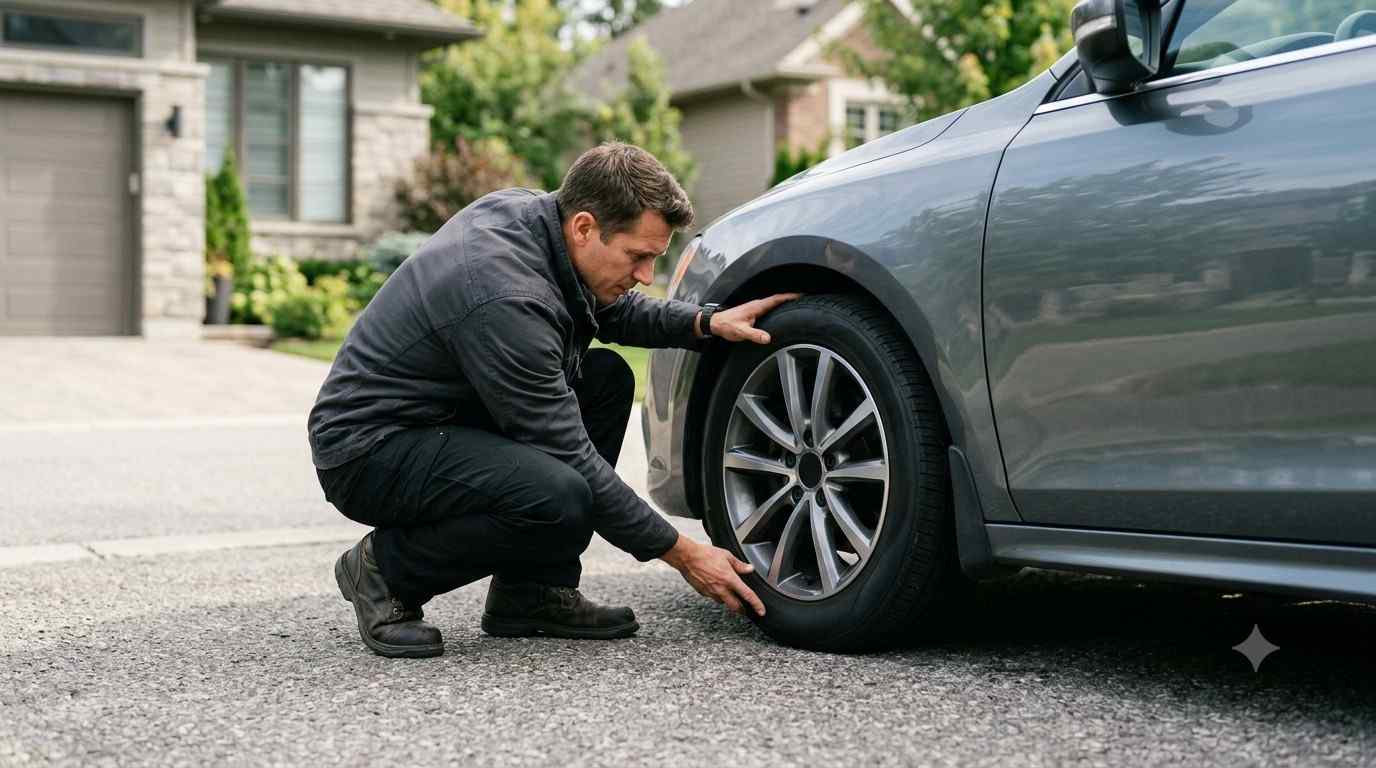
How to Check Tire Pressure Without a Gauge: Method 1 – The Visual Bulge Check
This is the fastest way to spot a low tire, and it takes about 10 seconds per tire. It’s usually the first thing drivers reach for when time is short.
- Park the car on flat, level ground.
- Walk around the vehicle and look at each tire from a few feet back, roughly at bumper height.
- Compare how much each tire “spreads out” where it meets the pavement.
A properly inflated tire holds a fairly consistent curve all the way around, with only a small, even flat spot at the bottom. A tire that looks noticeably squashed, wider at the base, or visibly bulging out to the sides compared to the others is very likely low on air.
Method 2: The Coin (Penny/Quarter) Test
Most drivers know the classic penny test for checking tread depth, but a similar coin trick can offer a rough clue about pressure, too.
How to do it:
- Take a quarter and hold it against the sidewall, near where the tire meets the road.
- Look at how much the sidewall bulges or flexes around the coin’s edge under the vehicle’s weight.
- Compare the same spot on all four tires.
A tire riding on too little air will show noticeably more sidewall flex and a flatter contact patch than the others. This isn’t a precise science, but paired with the visual bulge check, it adds a second data point before deciding a tire needs attention.
Method 3: The Sound and Bounce Test
Experienced drivers and shop mechanics often “read” a tire the same way you’d check a basketball — by bouncing the car gently or thumping the tire.
- Thump test: Knock on the tire’s sidewall with a knuckle. A properly inflated tire has a firmer, higher-pitched sound. A low tire sounds duller and more muted.
- Bounce test: Push down firmly on the corner of the bumper closest to the tire in question and let go. A well-inflated tire returns to position with one gentle bounce. A low tire feels mushy and takes longer to settle.
Method 4: The Hand Press Test
This is the simplest possible test and one almost every driver has done without realizing it has a name.
Press firmly on the tire’s sidewall with the palm of the hand. A tire at the correct pressure will feel firm and resist the push. A tire running low will feel noticeably softer and may even flex visibly under hand pressure.
It’s not precise — modern tires are built to handle a wide range of pressures while still feeling reasonably firm — but it’s a useful gut check before a trip, especially for spotting a tire that’s lost a significant amount of air overnight.
Method 5: Reading How the Car Drives
Sometimes the clearest sign of low tire pressure isn’t visual at all — it’s how the car behaves on the road.
| What the Driver Notices | Likely Cause |
|---|---|
| Car pulls slightly to one side | Uneven pressure between left and right tires |
| Steering feels heavier or looser than usual | Front tire(s) underinflated |
| Noticeably rougher ride over bumps | Could indicate overinflation, not underinflation |
| Increased road noise or a slight “wobble” | One tire significantly lower than the others |
| Fuel economy has quietly dropped | All tires running below recommended PSI |
None of these signs confirm a specific PSI number, but they’re often the first real-world clue that something needs a closer look — ideally with an actual pressure reading as soon as possible.
Method 6: Using a Gas Station Air Pump Display
This is the closest thing to an actual gauge reading without owning one personally. Most gas station air pumps — coin-operated or free — have a built-in pressure gauge on the hose fitting or a digital display on the machine itself.
- Remove the tire’s valve cap and set it somewhere safe.
- Press the pump’s fitting firmly onto the valve stem until the hissing stops.
- Read the current PSI on the display or dial.
- Add or release air as needed, then check the reading again.
Method 7: Letting Your TPMS Do the Work
Nearly every vehicle built after 2007 in the U.S. has a Tire Pressure Monitoring System. On many newer models, the infotainment screen can display the live PSI for each individual tire — not just a generic warning light.
- Check the owner’s manual or infotainment menu for a “tire pressure” or “vehicle status” screen.
- If the display only shows a warning light, that usually means at least one tire has dropped noticeably below the recommended pressure.
- TPMS readings can drift over time and aren’t a substitute for a gauge check every few months, but they’re a great early warning system between checks.
Comparison Table: Which Method Is Most Accurate?
| Method | Speed | Accuracy | Best Used For |
|---|---|---|---|
| Visual Bulge Check | Fast | Low | Spotting one obviously flat tire |
| Coin Test | Fast | Low | Second opinion after a visual check |
| Sound & Bounce Test | Fast | Low–Medium | Drivers with some experience |
| Hand Press Test | Very Fast | Low | Quick pre-trip gut check |
| Driving Feel | Ongoing | Medium | Catching pressure issues while on the road |
| Gas Station Pump Display | Moderate | High | An actual, precise PSI number |
| Vehicle TPMS Display | Instant | High | Real-time monitoring without stopping |
Why a Real Gauge Still Beats Checking Tire Pressure Without a Gauge
Every method above is genuinely useful in a pinch, but none of them can replace an exact number. Tire pressure that’s off by even 4–6 PSI can measurably affect braking distance and tread wear, and that kind of difference is very hard to detect by eye, hand, or sound.
A basic digital tire gauge typically costs less than a fast-food meal and fits easily in a glovebox or center console. For drivers who want one more layer of certainty, it’s worth keeping one in the car alongside a portable inflator for emergencies. Bridgestone’s own guide to checking tire pressure is a good source to bookmark for the exact PSI numbers recommended for your specific vehicle.
Related Guides on TireNearMeHub
Need Air, a New Gauge, or a Tire Inspection Nearby?
Find trusted tire shops and service centers near you in seconds.
Find a Tire Shop Near MeFrequently Asked Questions
Can you accurately check tire pressure without a gauge?
Not with pinpoint accuracy. Visual checks, the coin test, and the sound-and-bounce test can reveal a tire that’s significantly underinflated, but none of these methods can produce an exact PSI number. For that, a gauge or a gas station pump display is still the most reliable option.
How can I tell if my tire is low on air just by looking at it?
Park on level ground and look at each tire from directly behind the vehicle. A properly inflated tire shows a slight, even bulge at the bottom. A tire that looks noticeably flatter or more spread out at the base than the others is likely low.
Does the penny or quarter test work for tire pressure?
The classic coin test is designed for checking tread depth, but a similar coin-against-the-sidewall trick can hint at how much a tire is flexing under load. It’s a useful secondary clue, not a replacement for an actual reading.
Can I use a gas station air pump instead of my own gauge?
Yes. Most gas station air pumps have a built-in gauge on the hose or a digital display. Press the fitting onto the valve stem, read the current PSI, and adjust as needed — all in one stop.
How often should I check my tire pressure if I don’t own a gauge?
At least once a month, and always before a long trip. A basic digital gauge costs very little and is one of the cheapest ways to protect tires, fuel economy, and overall safety.
Final Thoughts on How to Check Tire Pressure Without a Gauge
Learning how to check tire pressure without a gauge is absolutely possible, and the seven methods above give drivers a real toolkit for spotting trouble before it becomes a bigger problem. The visual check, the coin test, and the hand press are perfect for a quick gut check in the driveway. Gas station pumps and a vehicle’s TPMS display step things up with an actual number to work from.
Still, none of these tricks fully replace the accuracy of a dedicated gauge. Keeping a small, inexpensive one in the glovebox — alongside knowing these backup methods — is the safest way to make sure every tire stays at the pressure it’s meant to be, trip after trip.